CASO DI STUDIO

Barcode-Integrated WMS Delivers 90% Inventory Accuracy for a Tile Wholesaler

A barcode-first warehouse overhaul that lifted inventory accuracy to 90%, slashed picking errors, and gave the business a live view of every pallet on the floor.

Vedi Tutti i Casi di Studio
Barcode-Integrated WMS Delivers 90% Inventory Accuracy for a Tile Wholesaler
Warehouse & Logistics

About the Company

This is a regional tile wholesaler, ceramic, porcelain, vitrified, stone, selling to independent retailers, contractors, and project developers across several markets. The warehouse holds thousands of pallets across dozens of product ranges, every line split into shade lots and caliber grades that must stay separated right through to delivery. Receipts arrive from manufacturers and importers daily; outbound fulfillment runs at the same pace. For an operation at this scale, knowing exactly what stock you have, and where it sits, is not optional.

The Challenges

Before the project, the warehouse ran on spreadsheets, handwritten tally sheets, and whatever the floor team could remember. Stock counts happened periodically, not continuously, and the figure in the system was almost never the figure on the rack.

Tile creates a specific problem that most other product categories don't have. Two boxes of the same SKU, pulled from different production runs, will look identical, same size, same glaze, same print on the box. But one is shade lot 4B and the other is 5A. Put them in the same order and the customer will see the difference the moment the tiles go on the floor. So returns happen. And when you're picking by memory, they happen often.

Inbound receiving was slow too. A truck would arrive, staff would count the pallet manually, paperwork moved to the office, and the receipt might not show up in the system for hours. Sales were quoting against those figures in the meantime, sometimes quoting stock that had just gone out on another order.

The numbers: inventory accuracy below 60%, and roughly one in twelve outbound orders generating a return.
Our Solution

Tiles IT Solutions put a barcode scan at every physical handoff in the warehouse. Receiving. Putaway. Picking. Dispatch. Nothing moves without being scanned, and every scan updates the stock count on the spot.

Each product variant, including every shade lot and caliber grade, got its own unique barcode label generated at the point of receipt. Staff work with handheld scanners. When a pallet comes in, they scan it against the purchase order; when it goes to a rack, they scan the bin location. When they pick for an order, the scanner tells them exactly where to go and which lot to pull.

Getting there took preparation. The existing catalog was a mess of supplier labels, some with barcodes, some without, some with codes that pointed to nothing in the new system. We spent a weekend going shelf by shelf through live stock, generating and affixing system labels to everything. Bin locations were mapped, numbered, and barcoded across the full warehouse footprint before a single order went through the new system.

The shade enforcement piece runs at the pick stage. When a picker scans a box, the WMS checks the lot against what the order actually requires. Wrong lot? The scanner alerts before the box goes on the trolley. The picker grabs the right one. That single check is what cut the mismatch returns.

Before and After Scenario

Before: A truck docked, staff counted by hand, paperwork moved slowly to the office, and stock might not show up in the system for hours. Pickers worked from memory and a printout. Shade-lot selection was a judgment call. About one order in twelve came back.

After: A delivery scans in within minutes of the truck arriving. Stock is live before the vehicle leaves the yard. Pickers follow a scanner-guided route, lot by lot, bin by bin. If something's wrong, the device catches it before the box gets to the packing bench. The annual full-count shutdown no longer happens, cycle counting runs in the background continuously.

Tech Stack

Odoo WMSOdoo WMS
NginxNginx
DockerDocker
PostgreSQLPostgreSQL
PythonPython
Zebra ScannersZebra Scanners

Business Outcomes

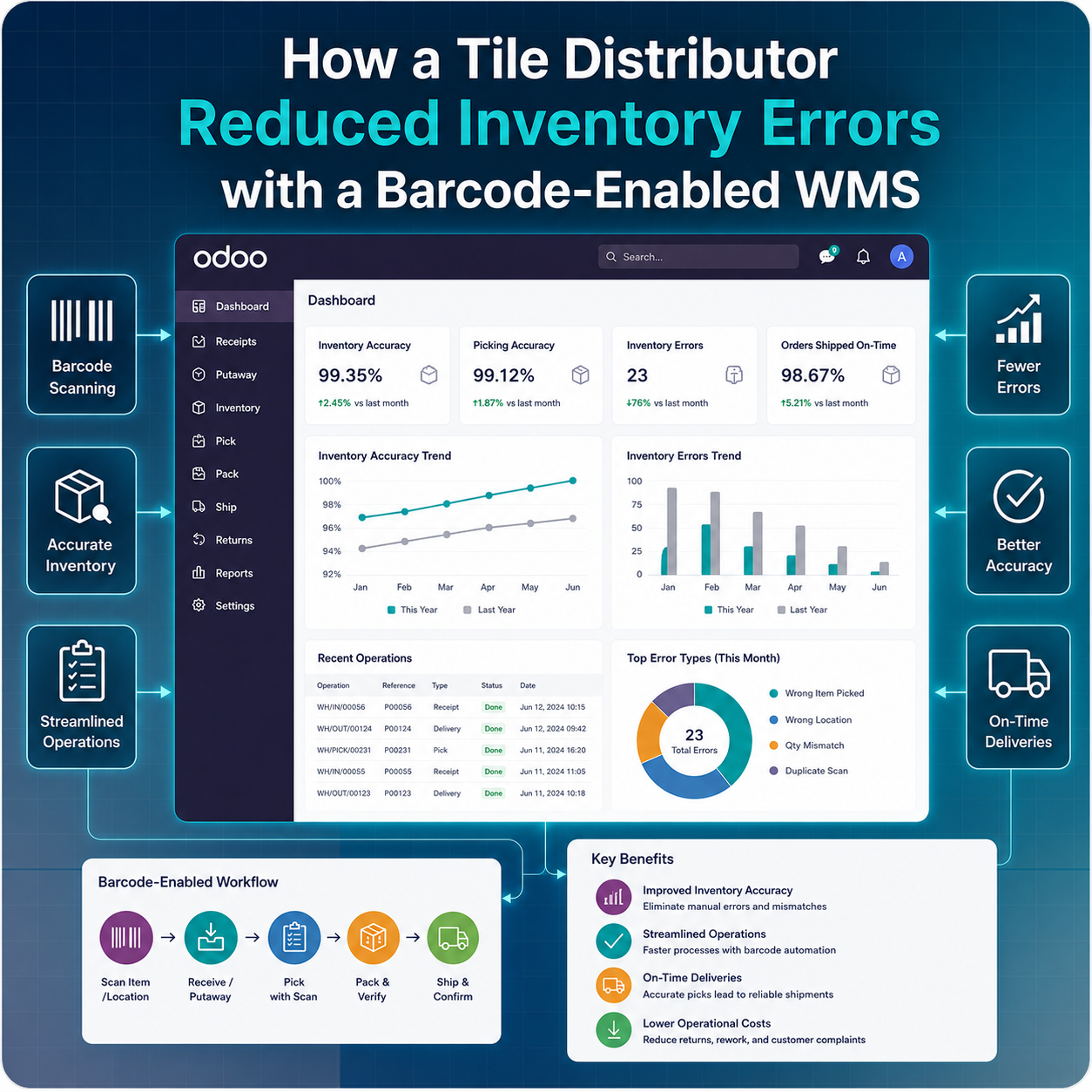
  • Inventory accuracy climbed from below 60% to above 90% across the full warehouse
  • Picking errors dropped by over 70%, with shade and caliber mismatches caught before dispatch
  • Inbound stock is live in the system within minutes of arrival, not hours
  • Lot-mismatch returns fell sharply in the first month after go-live
  • The annual full-count shutdown was eliminated, continuous cycle counting runs instead, saving roughly two full days of warehouse capacity each year

When stock accuracy is at 60%, the business is essentially guessing. Quotes are unreliable, picks are error-prone, and returns eat into margins that are already thin. Getting that number to 90%, and keeping it there, changes what the operation can promise to customers and how confidently it can grow.

Warehouse Logistics Dispatch
IL TUO PROGETTO È IL PROSSIMO

Pronto a Vedere Cosa Possiamo Costruire per Te?

Ogni progetto nel nostro portfolio è iniziato con una conversazione. Parliamo delle tue sfide.

Prenota una Consulenza