A headless storefront rebuild that delivered 68% more online orders, faster page loads, and scalable catalog performance.
Vedi Tutti i Casi di Studio
The enterprise is a multi-channel tile and surfacing distributor serving commercial contractors and an independent retail dealer network across several regional markets. It manages a catalog of more than 40,000 active SKUs spanning porcelain, ceramic, and natural stone, each available in multiple sizes, finishes, and matching trims. The business runs on contractor-specific tier pricing, a structured sample program, and a central inventory system that tracks stock across several distribution centers.
The distributor's website was built as a single, tightly connected system: the customer-facing pages and the heavy inventory and pricing database were locked together. For high-volume tile operations, that design buckles.
The catalog alone is a strain. One product line expands into dozens of variations once you account for size, finish, edge, and trim. On top of that, every visit to a product page had to pull two demanding pieces of data at the same moment: the logged-in buyer's negotiated tier pricing and live stock levels across multiple warehouses.
The page couldn't finish loading until all of that data came back. The result was load times near 5.8 seconds an eternity for a contractor checking quantities from a job site on a phone. Buyers gave up mid-order, carts were abandoned, and the overflow landed on the sales desk as phone orders that staff had to key in by hand.
Tiles IT Solutions rebuilt the storefront on a headless architecture. The idea is simple: separate the front design of the website from the heavy backend data so neither one slows the other down.
In the old setup, the page waited on the inventory system before it could appear. In the new one, the visual layer is prepared in advance and stored on a network of fast-loading servers positioned close to the buyer. Product pages now appear almost instantly, no matter how large the catalog grows.
The buyer's personalized details load a beat later, quietly in the background. As soon as the page is on screen, the system fetches that shopper's specific tier pricing, live stock, and freight estimate and fills them in without freezing or reloading the page.
The trickier part was contractor pricing. Every logged-in buyer sees a different price book, so those numbers can't be pre-loaded like a static product photo. We solved it with a lightweight data connection that retrieves each buyer's pricing and stock in under a second, then briefly remembers the result so repeat visits stay fast. A background sync keeps the displayed stock counts accurate without making the page wait on the inventory system.
The buyer experiences a fast page that simply shows the right price.
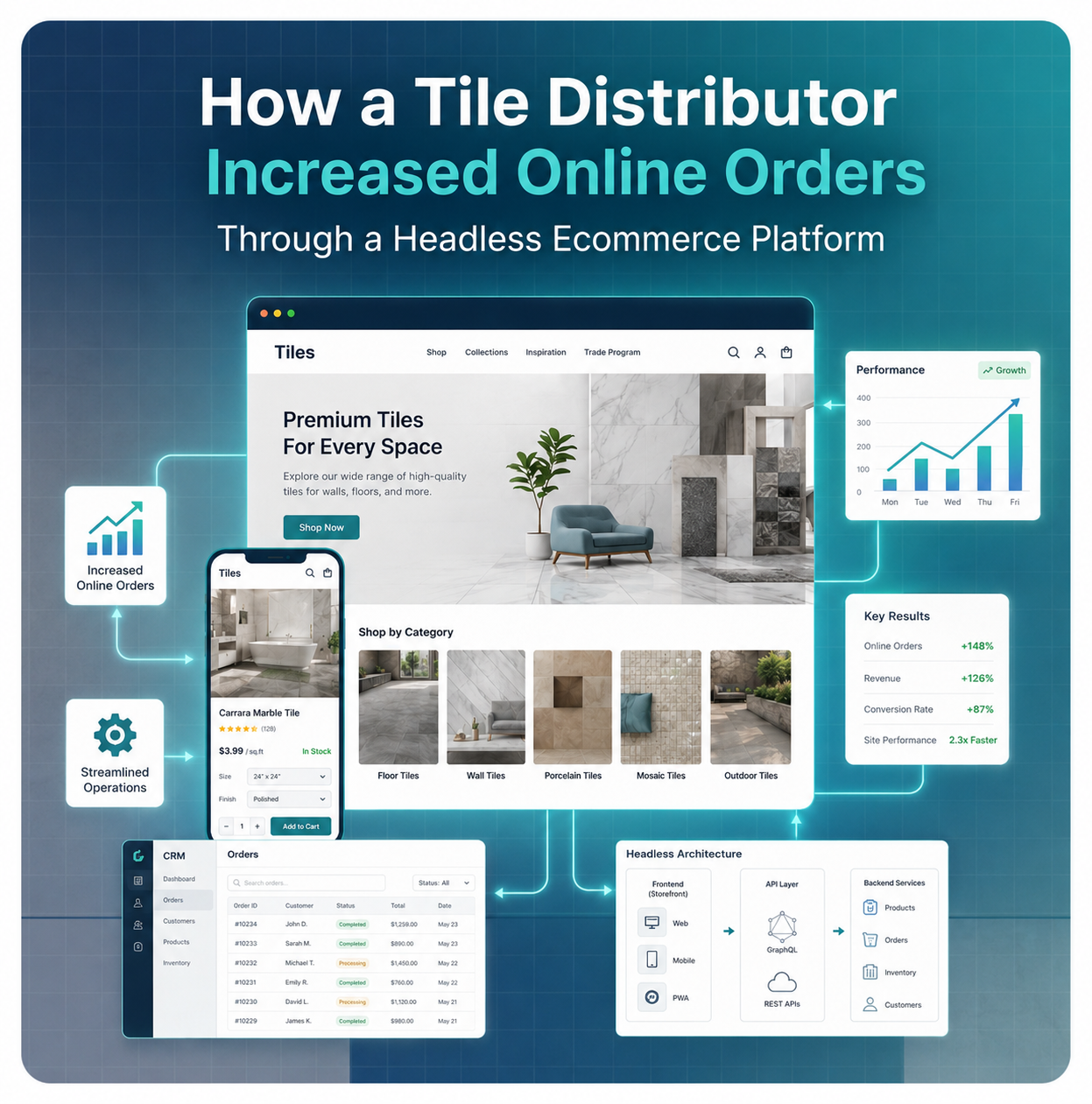
Before: A contractor opened a product on a phone, watched a loading wheel spin while the system fetched pricing and freight, and often abandoned the order then called a rep, who entered it manually. Sales staff spent their day as order-entry clerks.
After: The same contractor lands on a page that appears at once. Their negotiated pricing and current stock fill in within a fraction of a second. They size the room, confirm box-and-pallet quantities, and check out on their own. Reps return to selling instead of typing in orders.
Removing the bottleneck between the storefront and the inventory system is what turns a sluggish catalog into a sales channel that grows clearing the single friction point that had been capping digital growth for this tile operation.