A single catalog platform that brought 100,000+ SKUs under one roof, cut product data errors by 60%, and gave dealers and end buyers a search experience fast enough to actually use.
Vedi Tutti i Casi di Studio
This is a large-scale tile manufacturer and distributor carrying one of the widest product ranges in its regional market. The catalog spans ceramic, porcelain, vitrified, glazed, and natural stone across wall, floor, and outdoor applications. Each line runs across multiple sizes, surface finishes, edge profiles, shade lots, and matching trims. The business sells through a dealer network, direct to trade, and its own digital storefront. At full count, the active catalog sits above 100,000 SKUs.
A catalog that large does not manage itself, and this one was not being managed well.
Product data lived in three places. The ERP held base product records. A separate spreadsheet handled digital attributes, photography links, and web descriptions. The ecommerce platform pulled from both, inconsistently. Nobody owned the process end to end, so errors compounded over months. A product would have the right dimensions in the ERP and the wrong surface finish listed online. A shade lot would be discontinued in the warehouse but still showing as available on the website.
Search was the visible casualty. A dealer filtering for matte porcelain floor tiles above 600mm in a specific caliber grade would get no results, wrong results, or a timeout. The filtering logic sat on top of a standard ecommerce search tool never designed for this many attribute combinations. The buyers gave up. Sales reps talked customers through the catalog by phone because the website was not reliable enough to trust.
New launches made it worse. Adding a single collection meant updating three systems in the right order without missing a field. It took days. Errors in one system surfaced as wrong prices or missing images on the storefront two weeks later.
Tiles IT Solutions built a unified product information layer sitting between the ERP and the ecommerce storefront, so every piece of product data has one source and one path to the customer.
The ERP stayed as the system of record for stock, pricing, and ordering. Everything else, surface finish, dimensions, caliber grade, shade lot, imagery, technical spec sheets, and dealer-facing copy, was migrated into a central product data management layer. A GraphQL API feeds the storefront from there in real time. When a product attribute changes in the catalog, the storefront reflects it within minutes.
Search was rebuilt on Elasticsearch. Rather than forcing a standard ecommerce search tool to handle 100,000 SKUs with a dozen filterable attributes each, Elasticsearch indexes every product attribute as a searchable field. A dealer can filter by surface finish, size range, caliber, application type, and stock status simultaneously and get accurate results in under a second. Algolia handles front-end autocomplete on the dealer portal, so buyers start seeing relevant results before they finish typing.
The implementation hurdle was the existing data. Years of inconsistent entry across three systems meant duplicates, conflicting attributes, and live products with missing fields. A full data audit ran first, flagging every SKU with incomplete or conflicting records. The cleanup took six weeks. It was the least visible part of the project and the part everything else depended on.
Shade lot and caliber grade filtering required custom indexing logic, since neither maps cleanly to standard ecommerce product variants. Both were built as custom index fields with filters surfaced prominently in the dealer search interface.
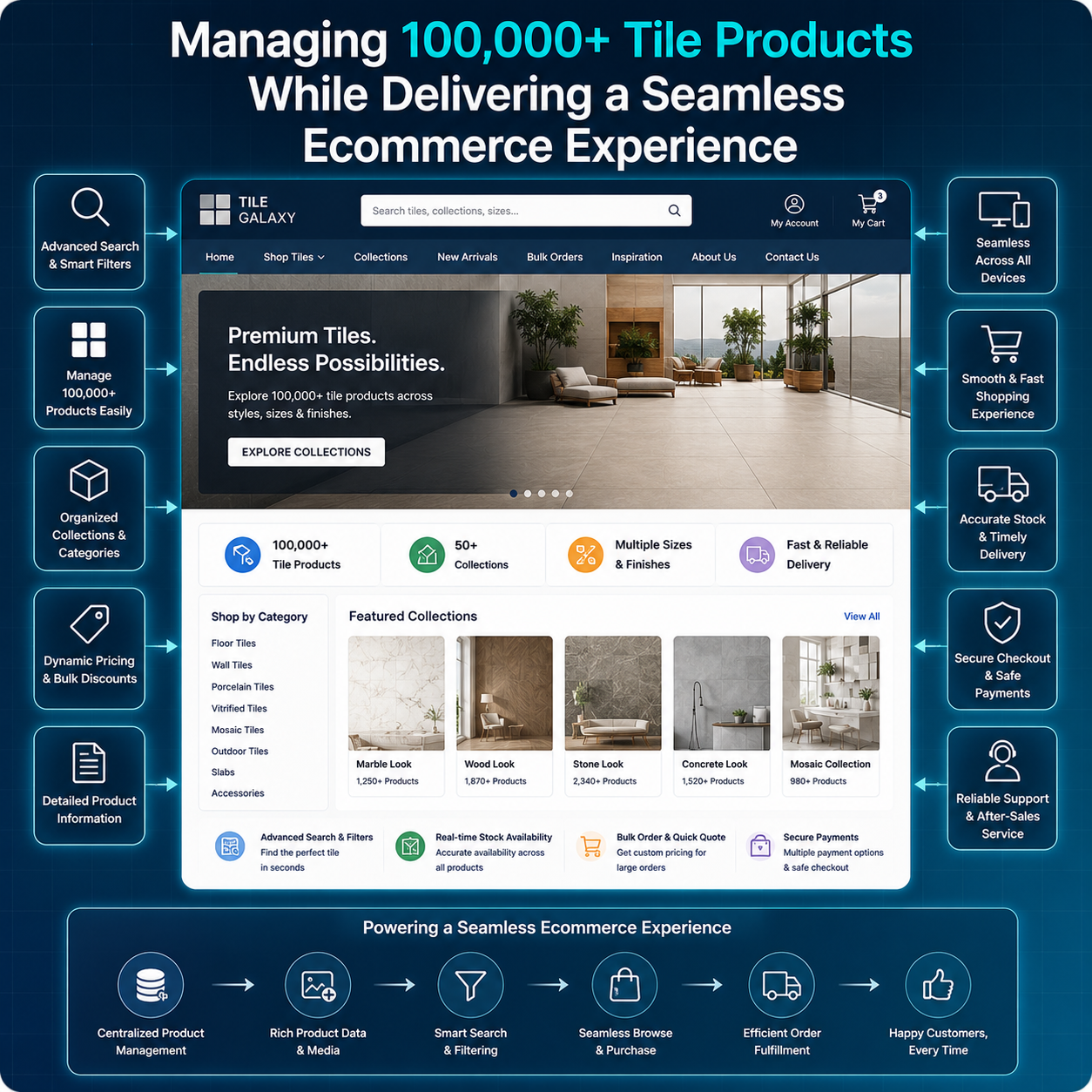
Before: Product data sat across three systems with no single owner. A new collection launch took days of manual updates across all three, and errors showed up on the storefront weeks later as wrong prices, missing images, or incorrect stock status. Dealers searching for specific tile specs got unreliable results and called sales reps instead of ordering online.
After: One central catalog layer feeds every channel. A product update happens once and reaches the storefront within minutes. Dealers filter by finish, size, caliber, and stock availability and get accurate results in under a second. New collection launches go live in hours, not days. The sales team handles real enquiries instead of talking people through a broken search filter.
A catalog of 100,000 products is only an asset if buyers can find what they need in it. When the data is inconsistent and the search breaks, the catalog becomes a liability instead. Getting the data clean, centralising it, and building search infrastructure that handles the real complexity of tile attributes is what turns a large catalog into a competitive advantage.