Tile plants live or die on small details. Lot numbers. Shade batches. Coverage math that has to survive the trip from square meters to boxes to a dealer’s floor. When that data sits in spreadsheets and tools that don’t talk, one rounding slip walks out the door as a short shipment. Sage ERP pulls production, inventory, and finance into a single system for tile manufacturers. Wire it up with the right ERP integration solution, and the shop floor finally connects to your dealers and online orders. Here’s what actually changes.
Why Traditional Systems Fall Short for Tile Manufacturers
Most business software treats a product as one fixed thing. Tile refuses to cooperate.
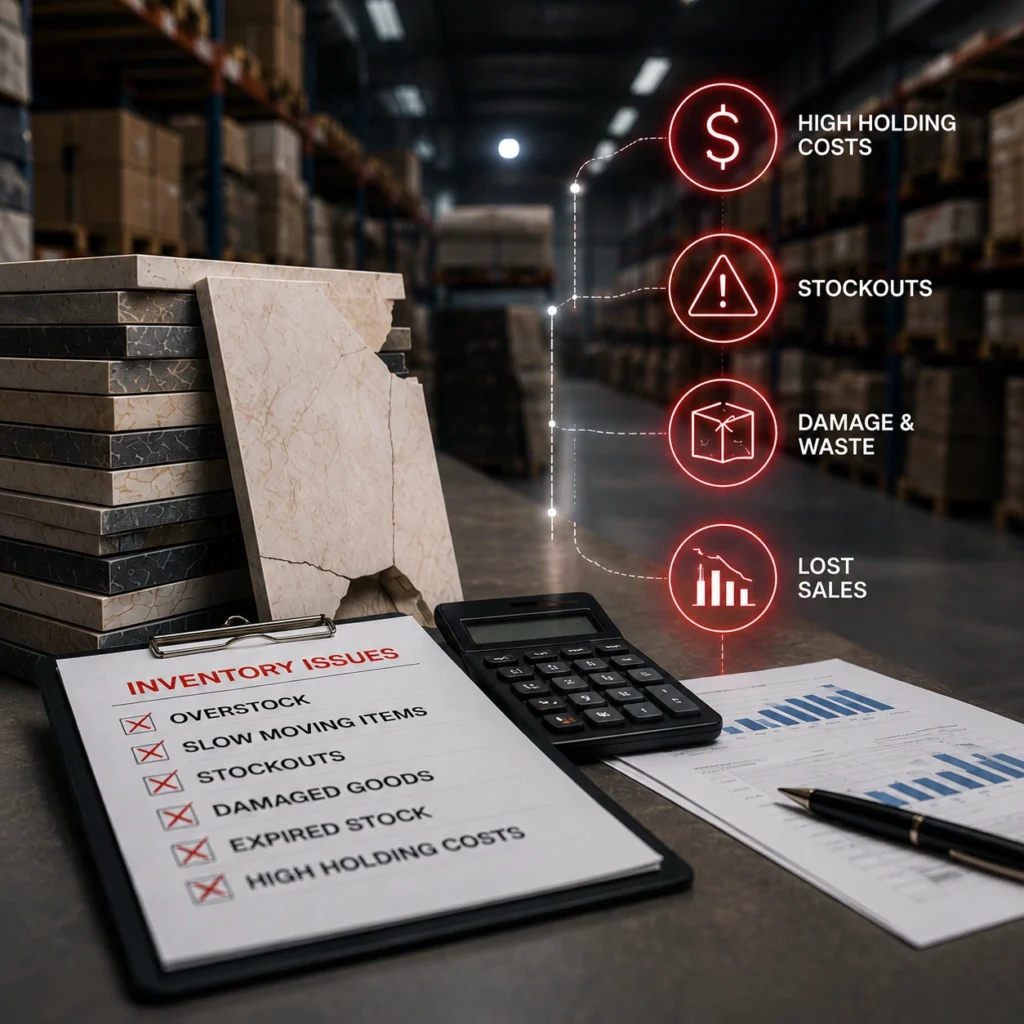
The same SKU ships in three shade lots that don’t quite match, and the contractor who mixes them across one bathroom floor will absolutely notice. You sell by the square meter but store by the box, so a single rounding error becomes a short shipment. Then stack on the rest. Multiple firing runs. Seconds and downgrades. Breakage in transit. A dealer network where every account expects its own price list.
Spread all of that across three warehouses and a showroom, and you’ve got the real operating picture.
Generic tools crack under it. That’s how plants end up running six apps that don’t share data, with a team burning every Monday morning reconciling numbers nobody quite believes.
What Sage ERP Offers Tile Manufacturing Businesses
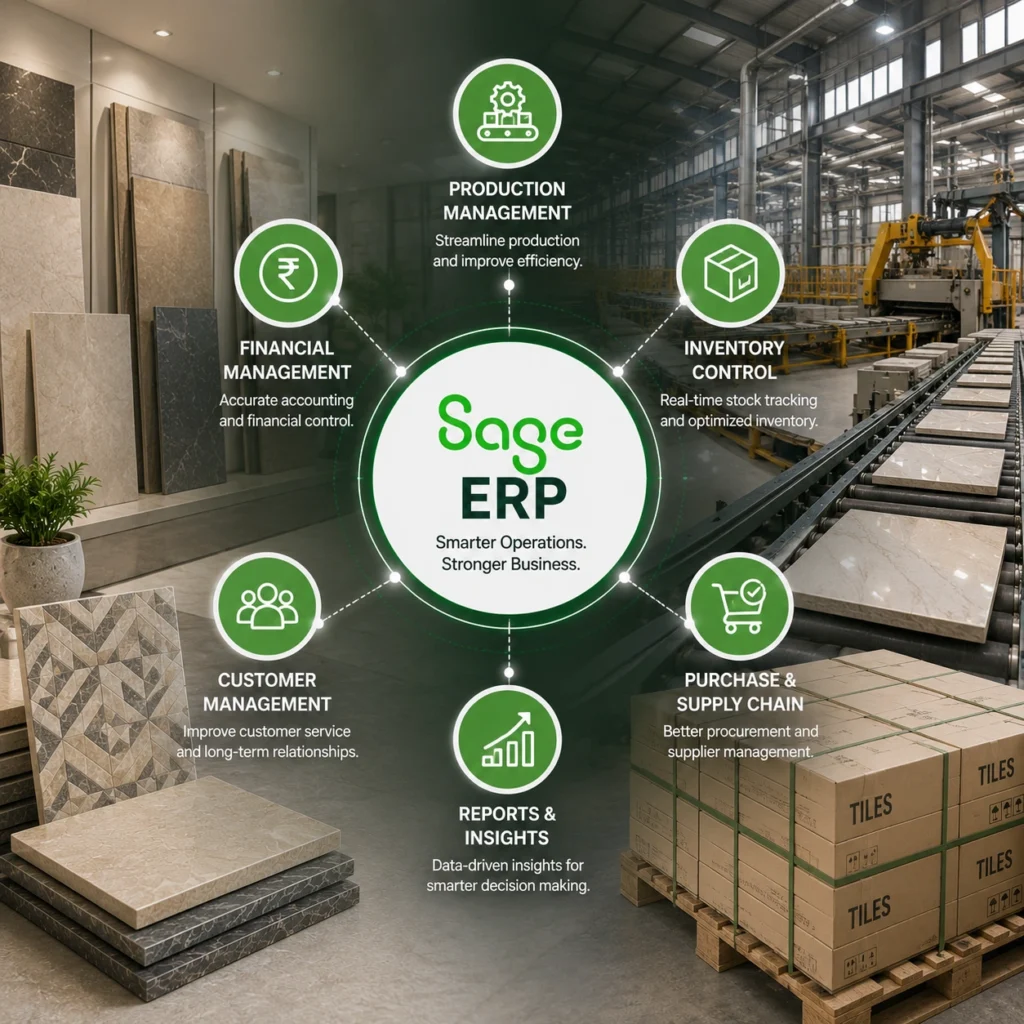
Sage ERP, and Sage X3 especially, was built to run manufacturing, distribution, inventory, and finance from one core. It covers discrete, process, and mixed-mode production, which is most of how tile actually gets made. Material planning, scheduling, cost tracking, and the general ledger all pull from the same data.
Translation: the quantity your planner sees is the quantity your accountant sees. No re-keying. One version of the truth instead of two arguing with each other.
So where does that help? A handful of specific places.
Key Benefits of Sage ERP for Tile Manufacturers
These are the areas tile teams tend to feel first. A couple you’d expect. One or two you won’t miss until they’re gone.
1. Production planning that tracks real demand
Plan by job, by order, or to stock, and switch when the situation calls for it. Material requirements planning works out what a run needs and when, so purchasing stops guessing. Scheduling respects machine capacity, labor, and setup time. That last one earns its keep. A kiln changeover can swallow hours, and Sage lets you sequence runs to dodge the expensive ones.
Fewer panic runs, less idle capacity. You build to what’s moving instead of last quarter’s ghost.
2. Inventory, lots, and shade variation
This is the part tile people actually care about.
Stock updates in real time across every site, and lot tracking keeps a shade run identifiable from the kiln to the loading dock. Three things that buys you:
- Trace a pallet back to its firing run when a dealer calls about a shade mismatch, in minutes instead of a warehouse scavenger hunt.
- See true on-hand stock by warehouse, not last night’s export pretending to be current.
- Catch a low-stock flag before it turns into a backorder and an awkward phone call.
Bolt Sage onto a purpose-built tile inventory system and that lot-level accuracy carries all the way to the customer. What the site shows is what’s on the pallet.
3. Simplify Financial Management
Finance is where an ERP quietly pays for itself. Sage automates the core accounting, handles multiple currencies, and speeds up month-end. Production costs report against budget as they happen.
The felt difference is simple. A close that used to eat a week starts landing in a few days. And the cost of a scrapped batch shows up while you can still do something about it, not a month later buried in a variance report.
4. Procurement and supply chain
Tile leans on inputs with real lead times. Clay bodies, glazes, packaging, freight, all moving at different speeds. Sage ties demand forecasting, supplier management, and procurement planning together, so you’re ordering against a plan rather than scrambling after a shortage.
One honest caveat. Forecasting is only as smart as the history behind it. Feed it clean sales data and it gets sharp. Drag years of messy spreadsheets into a fresh system and you should expect a tuning stretch before the numbers earn your trust.
5. Multi-site and multi-currency operations
Run more than one plant, sell across borders, or keep separate legal entities? Sage handles multiple companies, sites, and currencies natively. For an exporter who’d otherwise juggle parallel books and manual conversions, that alone can justify the whole project.
6. Quality control and traceability
Quality data attaches to products and production steps, with technical sheets living on the routing itself. For anyone tracking PEI ratings, water absorption, or batch consistency, that’s a far cleaner trail than a binder in the QC office and some crossed fingers.
7. Reporting you can actually act on
One platform, one source. Dashboards show sales by product and region, stock by location, and margin by run, without three exports duct-taped together in a spreadsheet at 6pm.
Where Sage ERP Falls Short for Modern Tile Businesses
Here’s the part the sales deck skips over. Sage runs the inside of your business beautifully. It is not your dealer portal, your storefront, or your customer-facing catalog.
The pattern repeats across the industry. A manufacturer rolls out Sage, sees real gains on the plant floor, then walks straight into a wall. Dealers still email their orders. The website quotes stock the ERP disagrees with. Somebody re-types web orders into Sage by hand, which is exactly the manual grind the ERP was supposed to kill.
That’s not Sage failing. It’s the gap between an ERP and the rest of a modern tile business. And it’s precisely where integration decides whether the money you spent turns into anything.
Connecting Sage ERP to the Rest of Your Business
To get the full return, Sage has to reach the systems your dealers and customers touch. Wired correctly, an order placed online or in a dealer portal drops into Sage on its own, inventory syncs both directions, and nobody re-keys a thing.
That’s the part we handle. Tile IT Solutions builds bidirectional integrations around Sage so data moves live instead of in overnight batches. In practice, that looks like:
- Two-way, real-time sync of orders, inventory, pricing, and customer records between Sage and your storefront
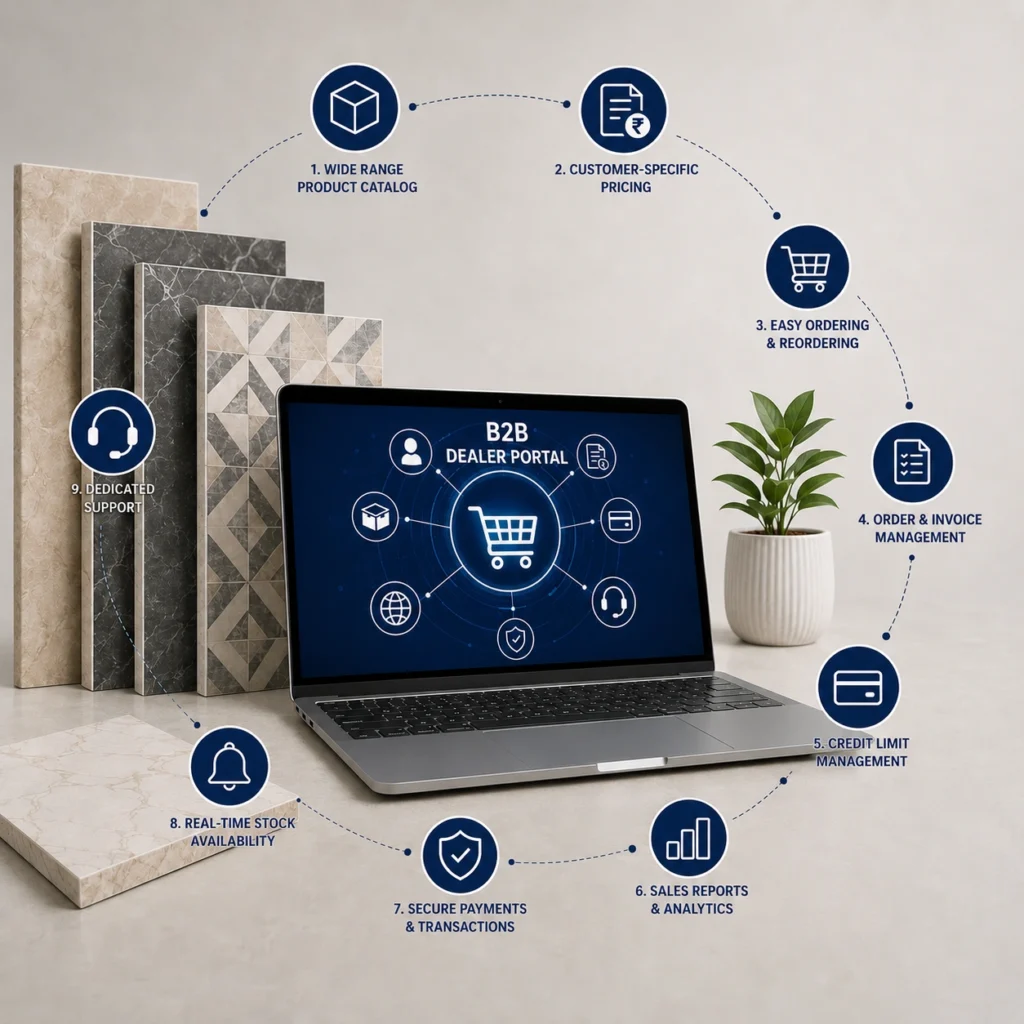
- A B2B dealer portal wired to Sage, so dealers self-serve orders that land straight in the ERP
- Your ecommerce platform linked to Sage with lot-accurate stock and tiered dealer pricing
- Custom middleware and API work for the legacy or niche tools Sage doesn’t speak to out of the box
- Data pipelines with error handling and audit logging, so a failed sync gets caught instead of quietly dropping an order
From our own projects, killing the manual re-entry is where teams report the sharpest drop in errors. Tile IT Solutions has integrated 45+ enterprise systems for tile companies, and stripping out hand-keyed data tends to cut accounting errors by around 90 percent. Our case studies show how that plays out on real projects.
Is Sage ERP the Right ERP Solution for Your Tile Manufacturing Business?
Sage isn’t the answer for every plant, and pretending otherwise would be dishonest.
One small line, a dozen SKUs, a single site? Something lighter will probably serve you better and cost less. Sage earns its price when complexity climbs. Multiple sites. Real lot and shade tracking. Exports. A dealer network that keeps growing. A production schedule that outgrew its spreadsheet two years ago.
Then there’s implementation, the factor everyone underweights. An ERP rollout is a project, not a purchase. Set aside budget for data cleanup, staff training, and a few months of tuning before it really hums. Manufacturers who treat it that way are usually glad they moved. The ones expecting a magic overnight switch tend to become the cautionary tale.
Sage gives you the backbone. Integration gives you the reach. Run them together and the plant stops reacting and starts planning.
Running Sage, or planning to? The value shows up when it’s connected to everything your dealers and customers touch. Tile IT Solutions builds Sage integrations made specifically for tile manufacturers, from real-time inventory sync to dealer portals and ecommerce. Request an integration assessment and we’ll map the fastest path to a connected operation.
FAQs
1. Is Sage ERP good for tile and ceramic manufacturers?
Yes. Sage ERP, especially Sage X3, supports discrete, process, and mixed-mode manufacturing along with lot and batch tracking, multi-site inventory, and quality control. Those features map well to tile production, where shade variation and lot consistency matter.
2. Can Sage ERP handle lot and shade tracking for tiles?
It can. Sage supports lot and batch genealogy, so a specific shade run stays traceable from production to dispatch. That makes it far easier to investigate a dealer’s shade complaint or manage seconds and downgrades.
3. Does Sage ERP connect to an ecommerce site or dealer portal?
Not fully on its own. Sage runs your internal operation well, but connecting it to a storefront or dealer portal needs integration work. Bidirectional integration lets online and dealer orders flow into Sage automatically and keeps stock in sync.
4. How long does a Sage ERP implementation take for a manufacturer?
It varies by scope, number of sites, and how clean your existing data is. Most manufacturers should plan for a multi-month rollout that includes data migration, testing, training, and a tuning period, rather than an overnight switch.
5. What’s the difference between Sage ERP and a dealer portal?
Sage manages production, inventory, and finance inside your business. A dealer portal is the customer-facing system your dealers use to place and track orders. They do different jobs and work best when integrated so orders move between them without manual entry.