
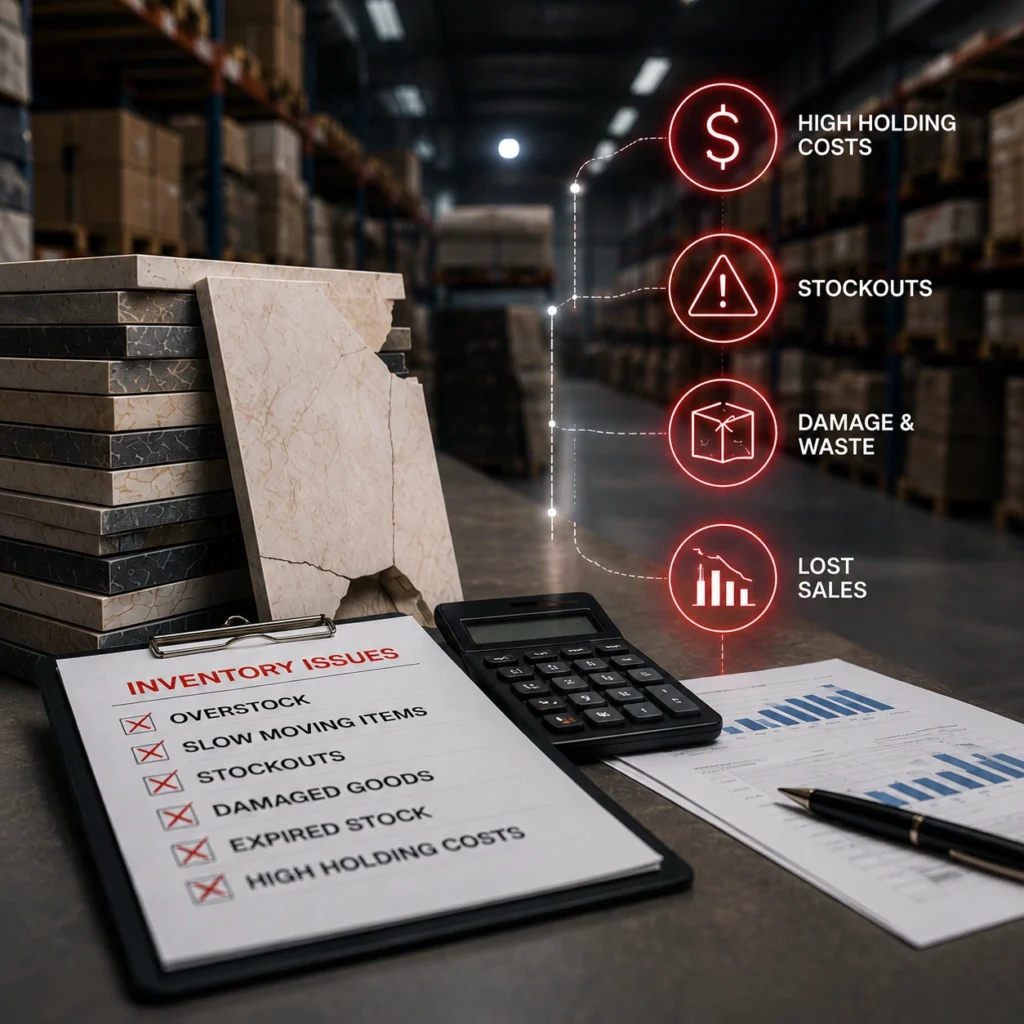

Most tile businesses know their inventory numbers are a little off. What they usually don’t know is what that gap costs them every month. It rarely shows up as one big loss.
It leaks out through cancelled orders, rush freight, replacement pallets, and hours of staff time spent verifying what a system should have already confirmed. Fixing it starts with visibility, which is exactly what a real time tile inventory management solution is built to give you.
What Poor Tile Inventory Management Actually Looks Like
It’s almost never a warehouse in chaos. That would be easy to spot.
Usually it looks like this. Your website says 480 square feet of a porcelain line is available. Sales quotes it. The customer pays. Then a picker walks the aisle and finds 320 square feet, half of it from a different lot. Now somebody has to make three phone calls, issue a partial refund, and hope the customer doesn’t walk.
Or it looks like a spreadsheet that was accurate on Friday afternoon and stopped being accurate around 9 a.m. Monday.
Other common versions:
- Two showrooms both promising the same pallet to different contractors
- Stock counted in boxes in one system and square meters in another
- Lot numbers written on a clipboard, not in any database
- Returns sitting in receiving for three weeks before anyone books them back in
- Nobody knows which SKUs haven’t moved in fourteen months
None of these feel like emergencies. That’s the problem. They feel like normal Tuesday.
The Hidden Costs of Poor Tile Inventory Management
Your P&L will show freight, labor, and cost of goods. It won’t tell you which portion of each was avoidable. Here’s where the money actually goes.
1. Lot and Shade Mismatches
This one is unique to tile and building materials, and it’s expensive.
A contractor orders 900 square feet. You ship 700 from one lot and 200 from another because the first lot ran short. The tiles are the same SKU, technically. But the shade variation is visible once they’re on the floor, and the installer stops work. Now you’re either shipping a full replacement from a matched lot or eating a labor claim.
Generic inventory software treats a SKU as a SKU. It has no concept of lot integrity. So it happily confirms an order it should have flagged.
2. Phantom Stock
Phantom inventory is stock your system says you have and you don’t. Damage that was never recorded. A transfer that was picked but never scanned out. A cycle count adjustment somebody skipped.
The cost isn’t the missing tile. It’s the cancelled order, the refund processing, and the customer who now checks your competitor first next time. That last part compounds and nobody puts a number on it.
3. Emergency Freight and Rush Orders
When you find out you’re short after the order is confirmed, you pay for speed. Expedited freight on a pallet of tile is not cheap, and heavy fragile goods make it worse.
Reactive buying also kills your negotiating position with mills. You’re ordering small quantities on short notice instead of consolidating. On our own implementations, the inventory systems we deploy have driven roughly a 35 percent reduction in emergency orders once forecasting and reorder alerts are running properly.
4. Staff Time Spent Verifying Things
Add up the hours your team spends on:
Walking the warehouse to confirm a quantity. Calling another branch to ask what they’re holding. Re checking a count because the last one looked wrong. Explaining a discrepancy to a dealer.
For a distributor with three locations, that’s frequently a full time role’s worth of work spread thin across five people. Nobody has it on a job description. It just happens.
5. Dead Inventory Nobody Flagged
Slow movers are quiet. They don’t cause complaints. They just sit on racks, occupy space you’re paying for, and tie up working capital.
Then the mill discontinues the line, or the format goes out of style, and what you’re holding is worth a fraction of what you paid. Seconds and downgrades pile up the same way.
The fix is boring but real. You need visibility on aging stock early enough to discount it while it still has value. Most tile businesses find out too late.
6. Damage and Breakage With No Owner
Tile breaks. That’s expected. What’s not acceptable is not knowing where.
Without scanning at each movement, you can’t tell whether breakage is happening in receiving, during internal transfers, or in outbound packing. So you can’t fix the cause. You just absorb it as shrinkage every year and move on.
An audit trail on every movement is what turns that from a mystery into a solvable operations problem.
7. Dealer Trust
Hardest cost to measure, biggest long term impact.
Dealers plan their own jobs around your availability data. Get it wrong twice and they start dual sourcing. They don’t announce it. Your volume just softens over two quarters and the reason never makes it into a report.
Must Read: Common Tile Inventory Management Problems & Solutions
How Much Is Poor Inventory Management Costing Your Business?
Don’t take anyone’s benchmark for this. Pull your own numbers for the last twelve months:
- Total value of orders cancelled or amended due to stock unavailability
- Freight spend flagged as expedited or emergency
- Value of replacement shipments sent for lot or shade mismatch
- Written down or heavily discounted stock older than 12 months
- Estimated staff hours spent on manual stock verification, times loaded hourly cost
Add those five. For most mid sized distributors the total is uncomfortable, and it’s almost always larger than the cost of fixing the underlying system.
Worth doing before you talk to any vendor, including us. It gives you a real baseline instead of a vague sense that things could be better.
Why Spreadsheets Are No Longer Enough for Tile Inventory Management
Spreadsheets are fine at one location with one person updating them. Genuinely fine. Don’t rip out something that works.
They break at predictable points. Second warehouse. Ecommerce going live. Dealer portal launch. Anything that means two people need the same number at the same moment.
The failure isn’t the spreadsheet. It’s that a spreadsheet can’t be the single source of truth for a website, a sales team, and a picker with a scanner all at once. Something has to reconcile them, and manual reconciliation always lags.
How to Fix Poor Tile Inventory Management
Six capabilities do most of the heavy lifting. Not all of them matter equally for every business.
1. Real Time Tracking on Every Movement
Received, scanned in, transferred, shipped. Each movement updates stock instantly and writes to an audit trail. That trail is what lets you investigate discrepancies later instead of guessing at root causes.
2. Multi Location Visibility
All warehouses, showrooms, and distribution centers on one dashboard. You see stock by location, move it between sites, and get automatic transfer suggestions when one location is overstocked while another runs short. Positioning stock correctly cuts shipping cost before you’ve negotiated a single freight rate.
3. Barcode and RFID Scanning
Receiving staff scan incoming shipments to confirm them. Pickers scan during picking and packing. This is the single biggest driver behind a 95 percent reduction in inventory errors, because it removes manual data entry from the equation entirely. RFID on high value items adds theft prevention.
4. Lot and Serial Number Tracking
The one that matters most in tile. Every tile carries its lot number in the system, so shade matching becomes a rule the software enforces rather than something a salesperson remembers. If a quality issue surfaces, you identify every affected order immediately and isolate the batch.
5. Demand Forecasting
Historical sales, seasonal patterns, and market trends feed projections. You get alerted before stock crosses its reorder point, not after. Same engine flags slow movers early, which is how you avoid the dead inventory problem described above.
6. Cycle Counting
Counts run on a schedule without shutting the warehouse down. High value items get counted more often. Discrepancies get flagged with support for root cause analysis, whether that’s damage, theft, or a keying error. You maintain accuracy without annual full physical inventories.
Also Read: Best Practices for Tile Inventory Management
What It Takes to Implement a Modern Tile Inventory Management System
Four phases. Timelines vary with the number of locations and the state of your existing data.
- Warehouse audit: Current operations, inventory processes, and system integrations get reviewed. Optimization opportunities and barcode or RFID requirements are mapped before anything gets built.
- System implementation: Rollout across all locations, with barcode scanning, RFID, and automated workflows configured. Integration with your existing ERP and warehouse systems happens here. Forecasting algorithms get trained on your historical data.
- Staff training: Hands on sessions at each warehouse, plus documentation. Skip this and adoption fails. It’s the phase companies most often try to compress, and it’s the wrong one to cut.
- Continuous optimization: Ongoing accuracy monitoring, cycle count discrepancy analysis, and monthly reporting on inventory metrics.
The Trade-Offs of Upgrading Your Inventory Management Process
Not everything about this is upside.
Data cleanup is the unglamorous part. If your current records are messy, somebody has to reconcile them before go live, and that work lands on your team as much as ours. Budget for it.
Warehouse staff resistance is real, particularly where people have run the floor by memory for fifteen years. Scanning feels like extra steps at first. It stops feeling that way around week three, but week one is genuinely rough.
And if you’re a single location retailer with under a few hundred SKUs, a full inventory system may be more than you need right now. Tighter processes and a better spreadsheet discipline might get you most of the way there. We’d rather tell you that than sell you something oversized.
Where it clearly pays off: multiple locations, lot sensitive product, an ecommerce channel promising availability, or a dealer network depending on your numbers. If two or more of those apply, the leakage is already costing you more than the fix.
Find out what your inventory gap is actually costing you.
Pull your last twelve months of cancelled orders, expedited freight, and aged stock. Bring the numbers. We’ll walk through where the leakage is coming from and whether a system change is worth it for your operation.
FAQs
1. What is phantom inventory in a tile warehouse?
Stock your system shows as available that physically isn’t there. Usually caused by unrecorded damage, unscanned transfers, or skipped count adjustments.
2. Why does lot tracking matter more for tile than other products?
Shade varies between production lots. Ship two lots on one order and the variation shows up on the finished floor, which means a replacement or a labor claim.
3. How much does poor inventory management actually cost?
It varies widely. Add up cancelled orders, emergency freight, replacement shipments, written down stock, and manual verification hours to get your own figure.
4. Can I keep using spreadsheets?
At one location with one person updating them, often yes. Once a website, a second warehouse, or a dealer portal needs the same number in real time, no.
5. Will this integrate with our existing ERP?
Yes. ERP and warehouse system integration is part of the implementation phase, not a separate project.
6. How long before we see accuracy improve?
Scanning improvements show up fast, usually within the first few weeks of consistent use. Forecasting accuracy needs a few months of data to settle.

