A single connected ERP that linked sales, production, and dispatch cutting order-to-dispatch time by 40% and ending repeated manual data entry.
View All Case Studies
The enterprise is a ceramic tile manufacturer operating several production lines and kilns that supply a distributor network and large-format retail buyers across multiple regional markets. Its output spans glazed ceramic and porcelain tiles in a wide range of sizes, designs, and surface finishes, with every production run sorted into shade and caliber lots. The company manages its own raw-material stores, finished-goods warehouses, and a dispatch yard, fulfilling both made-to-stock lines and made-to-order volumes.
On paper the operation looked efficient. In practice, every department worked in isolation. Sales booked orders in one application, production planners scheduled runs on spreadsheets, the warehouse kept stock in a separate ledger, and dispatch ran on printed pick lists. The same order was keyed in four times as it moved down the line.
That fragmentation cost time at every handoff. A confirmed order sat in an inbox until a planner manually slotted it into the production schedule. Finished stock was hard to locate because the ledger always lagged behind the floor. Worst of all, matching the right shade and caliber lot to an order was a manual lookup and a wrong match meant a rejected delivery and a costly return.
Order-to-dispatch stretched to roughly five working days, and customers complained about both the wait and the occasional mismatched shipment.
Tiles IT Solutions consolidated the entire operation onto a single Odoo ERP platform, connecting Sales, Inventory, Manufacturing, and Purchase in one system. An order now enters once and flows through every stage without re-entry.
When sales confirms an order, the manufacturing module sees the demand immediately and planners schedule production against live capacity. As tiles come off the line, the warehouse records them straight into stock, so finished-goods counts are accurate the moment a pallet is wrapped. Dispatch works from that same live data instead of a printout.
The hardest part was shade and caliber. Ceramic tiles from different production runs vary slightly in tone and dimension, so a single order must ship from one matching lot something a standard ERP setup ignores. We configured Odoo's lot tracking alongside product attributes and picking rules, so each finished batch is tagged with its shade and caliber and dispatch automatically reserves stock from a single matching lot. We also mapped the manufacturer's box, square-meter, and pallet measurements into the system so quantities convert correctly at every step.
The result is one connected flow from order to truck, with the shade-matching logic built in rather than left to memory.
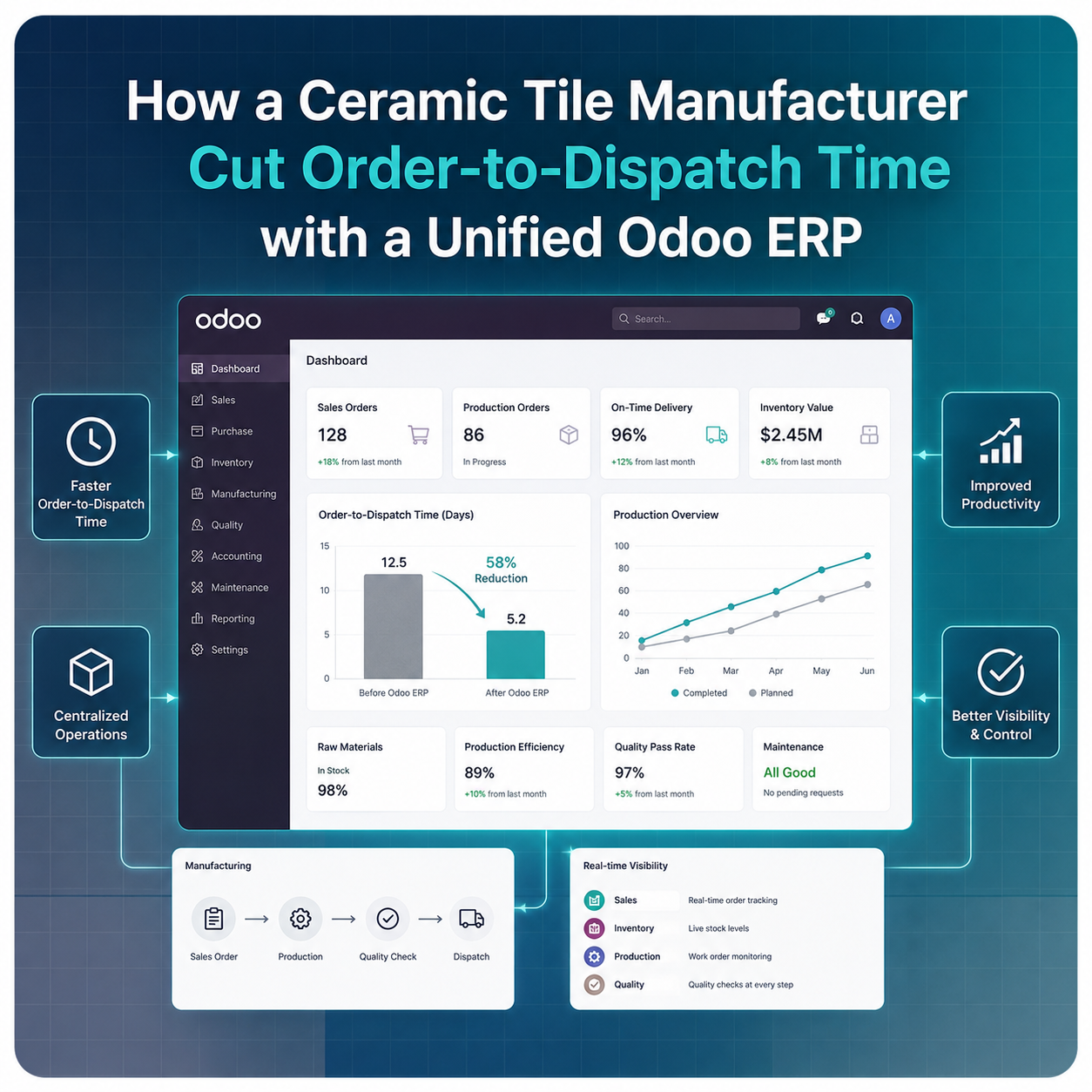
Before: A booked order was re-typed by sales, planning, the warehouse, and dispatch in turn. Planners chased the floor for stock updates, and a clerk hunted for a matching shade lot by hand. A typical order took about five days to reach the dispatch yard, and mismatched shipments were a recurring complaint.
After: An order is entered once and is visible to every department in real time. Production is scheduled against live capacity, stock is accurate to the pallet, and dispatch pulls a single matching shade and caliber lot automatically. The same order now reaches the truck in about three days.
Unifying sales, production, and dispatch on one platform removed the manual handoffs that had quietly added days to every order turning a fragmented workflow into a predictable, scalable production-to-delivery line.