
A homeowner in Fremont just typed “waterproof flooring for basement” into her phone. She’ll click one of the top three results. Request two quotes. Book someone by Sunday. If your flooring business isn’t in that top slot, you didn’t lose a click. You lost a $6,000 job. That’s how fast flooring buyers move once they start searching.
Below are ten strategies built for flooring retailers, installers, distributors, and showrooms that actually want to rank. If you’d rather have someone else run them, our tile and flooring digital marketing services team does exactly that.
Why SEO Matters for Flooring Companies
Flooring buyers are weird. They’ll spend three weeks reading about engineered hardwood, then pick an installer in an afternoon. They ask oddly specific things like “can LVP go over slightly wavy concrete.” They compare five contractors before calling one. And most of them are searching on a phone, standing in the room they want floored, imagining what a herringbone pattern would look like.
Your site has to meet all of that. Here’s how.
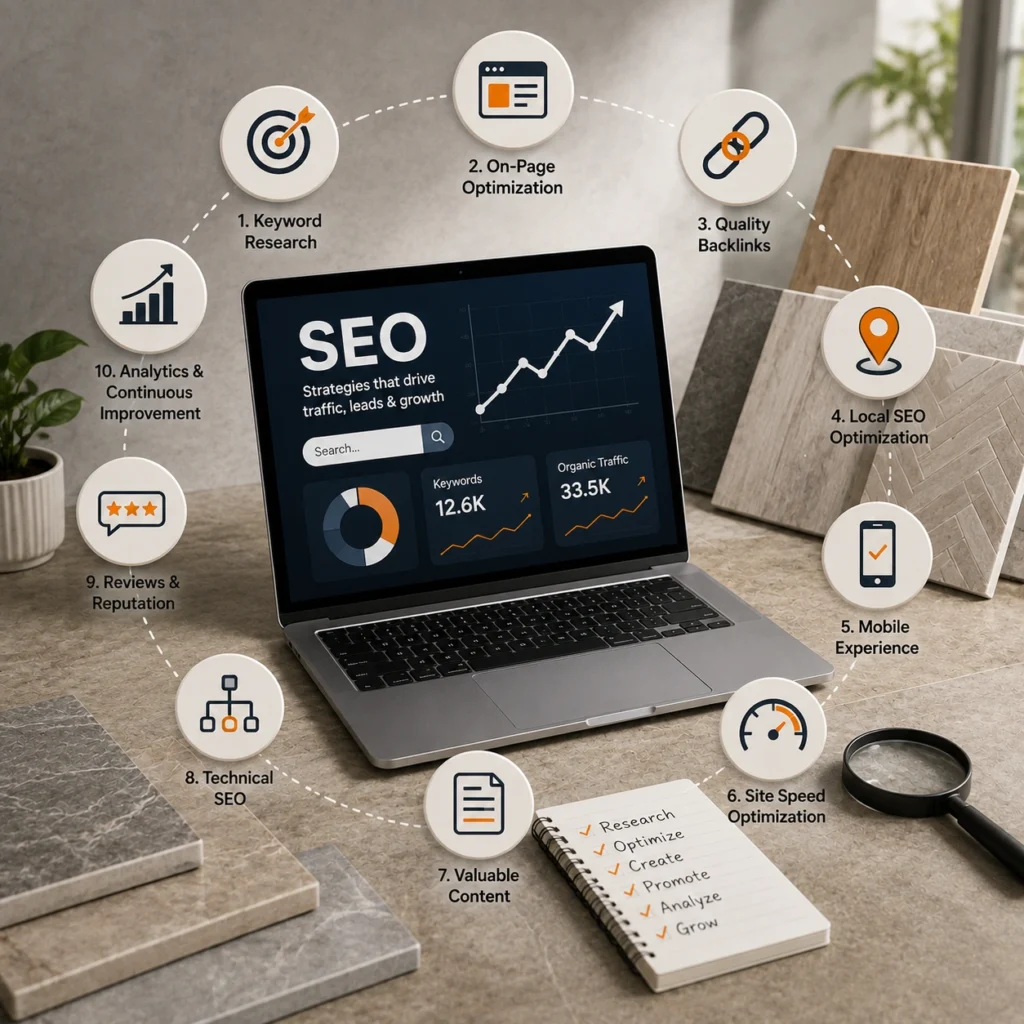
10 SEO Strategies for Flooring Companies
Some of these are foundational. A couple get tactical. All of them come from watching what works for real flooring companies, from one-showroom family shops to national distributors.
1. Map the Flooring Buyer’s Search Journey
Most flooring sites are built around what the company sells. That’s backward. Build around how people actually shop.
Roughly four stages:
Awareness. Someone asks Google “what flooring holds up with kids and a dog.” They’re not buying yet. They just want an answer.
Consideration. Now they’re comparing. “Engineered hardwood vs LVP for kitchens.” A blog post can win this.
Comparison. Prices enter the picture. “Cost to install 1,000 sq ft of vinyl plank in California.” Give them a real range or lose them.
Decision. This is the money query. “Best hardwood installers in Sunnyvale open Saturday.” Local page, click to call, done.
Skip a stage, leak leads. Own all four, own the buyer.
2. Optimize Your Google Business Profile for Local SEO
The Google map pack, those three local listings with the little map, drives more flooring revenue than any other search feature. Somebody typing “carpet stores near me” isn’t browsing. They’re buying this week.
Getting in takes three things, done boringly well:
Fill out every field on your Google Business Profile. Every one. Categories, services, attributes, hours, holiday hours, real photos of your showroom (not stock shots), weekly posts.
Keep your name, address, and phone consistent across Yelp, Houzz, Angi, HomeAdvisor, BBB, the World Floor Covering Association directory, your local chamber. Inconsistent citations quietly tank rankings and nobody notices for a year.
Ask for reviews within 24 hours of finishing a job. That’s when the customer’s happiest. Wait a week and half of them forget.
Also, claim Apple Business Connect. iPhone users default to Apple Maps. Ignoring them means ignoring a lot of buyers.
3. Create Local Service Pages for Every City You Serve
A single “Service Areas” page won’t rank you in five towns. Never has. Each combination needs its own page.
For a Bay Area flooring business, that means real pages like:
- Hardwood Flooring Installation in Fremont
- LVP Installation in Union City
- Tile Repair Services in Newark
- Commercial Carpet Supply in Milpitas
- Bathroom Tile Installers in Palo Alto
Here’s the trap. Most agencies spin up thirty near-identical pages with just the city name swapped. Google’s Helpful Content System eats those alive.
Each page needs actual local substance. Neighborhoods you serve. Photos from real jobs in that town. A testimonial from an actual local client. A note about local quirks, like coastal humidity making solid hardwood a bad idea in some Bay Area homes, or the extra permits some HOAs demand for balcony tile.
Slower to build. Actually ranks.
4. Optimize Flooring Service Pages for Search and Conversions
Ranking is half. Converting is the other half. Most flooring service pages get one right and blow the other.
A page that does both usually has this anatomy:
| Section | What it does |
| Hero + clear CTA | Tells the visitor in three seconds they’re in the right place |
| Problem framing | “Worn carpet in a house with two kids and a lab?” |
| Service overview | What’s included, what isn’t |
| Process | Consultation, measure, quote, install, warranty |
| Materials and brands | Signals expertise, catches brand name searches |
| Real project gallery | Before and afters from your own area |
| Pricing ranges | Even a rough $6 to $10 per sq ft is enough |
| Reviews for that service | Social proof at the decision point |
| FAQ | Snippet bait, and it kills objections |
| Sticky quote form | Especially on mobile |
Pricing ranges made the list on purpose. Most flooring companies dodge it. But adding even a rough number filters out tire kickers and roughly triples qualified inquiries. Tested it across a dozen clients. Works every time.
5. Optimize Flooring Product Pages for SEO
If you sell tile or planks online, every SKU is a ranking opportunity. Most flooring sites waste it completely.
The mistake? Pasting the manufacturer’s product description word for word. Google sees that as duplicate content. Your page ranks below the manufacturer’s, below Home Depot, below every other dealer using the identical copy.
Rewrite each one with actual usefulness:
- Which rooms it suits (kitchen, bath, basement, high traffic commercial)
- Installation method (glue down, floating, nail down)
- Wear rating and warranty in plain English
- Care and cleaning
- What pairs with it (trim, underlayment, adhesive)
- Real photos taken on your showroom floor, not renders
At two thousand SKUs, this stops being a copywriting job and becomes an operations one. Our ecommerce and catalog solutions automate bulk optimization at that scale so product pages actually pull traffic.
6. Create Helpful Content for Flooring Buyers
Flooring blogs work when they answer real questions. They fail when they read like SEO padding.
Seven content categories that consistently pull traffic:
- Material comparisons: Engineered vs solid hardwood. LVP vs laminate for basements. Porcelain vs ceramic in wet areas.
- “Best flooring for X” guides: For pets. For kids. For rentals. For basements. For high traffic homes. For elderly parents worried about slipping.
- Cost breakdowns: Real ranges. “Tile install in a 40 sq ft bathroom typically runs $2,800 to $4,500 in the Bay Area including labor and materials.” That’s the kind of specificity that ranks and converts.
- Care and maintenance: How to clean travertine without ruining it. How often hardwood really needs refinishing. What to do when someone spills red wine on carpet at 11pm.
- Design inspiration: Trending patterns, colors, tile layouts, wood species.
- Local case studies: “How we replaced 2,400 sq ft of subfloor in a 1958 Fremont ranch that had never been touched.”
- Troubleshooting: Squeaky floors. Cupping hardwood. Grout going grey. LVP separating at the seams.
A cadence that works for most companies: two blog posts a month, one local landing page a month. That’s it. Twelve months later you’ve got 24 posts and 12 city pages all pulling traffic while you sleep.
7. Optimize Flooring Images and Videos for SEO
Flooring is visual. Nobody buys it sight unseen. Your images and videos aren’t decoration, they’re ranking assets.
Every product photo needs a real filename (herringbone_oak_hardwood_natural_finish.jpg beats DSC_4471.jpg), alt text describing what’s actually shown, compression under 200KB where you can, and image schema on product pages.
Video’s even more underused. Install walkthroughs. Showroom tours. Two minute material comparisons. The customer’s reveal moment when they see their new floor for the first time. YouTube’s the second biggest search engine and flooring videos rank there for years.
The other piece: buyers want to see what a specific tile or plank will look like in their room before they commit. Our 3D and AR product visualization tools solutions let shoppers preview flooring on their own phone camera. Time on page goes up. Sample requests go up. Quote conversion goes up. Every metric that matters, up.
8. Target Featured Snippets and People Also Ask
Featured snippets sit above the regular results at position zero. On flooring queries they can pull 30 to 40% of clicks. Most flooring companies never even try for them.
Questions worth targeting:
- How long does vinyl plank flooring last?
- Is laminate flooring waterproof?
- Can you install tile over concrete?
- How long does hardwood installation take?
- What’s the best flooring for a bathroom?
Structure the answer this way. Open with a direct 40 to 60 word response right at the top of the section. Then the detailed explanation, with bullets, a table, a photo, whatever fits. Wrap the FAQ block in FAQ schema so Google can find the structured content.
Do it on ten pages. You’ll see snippet wins inside two months.
9. Build Local Backlinks for Your Flooring Business
Ten links from tile industry publications, local news, and design blogs beat a thousand from directory farms. Every time.
Where flooring companies can actually earn them:
Local news coverage of a big install project. That commercial gym floor you did in San Jose? Pitch it to the neighborhood paper. Guest posts on home improvement and interior design blogs. Getting quoted in Houzz articles or Better Homes & Gardens. Partnerships with builders, real estate agents, property managers, interior designers. Sponsoring a charity 5K or a Little League team. Membership in trade associations (NWFA, TCNA, CTDA) that include a directory backlink.
What to avoid: anything advertising “100 backlinks for $99.” Google’s spam updates keep getting sharper, and cheap link schemes will cost you rankings faster than they earn any.
10. Scale Properly for Multiple Showrooms
Multi location flooring brands have a different problem. Being consistent as a brand while ranking locally in each spot.
Site structure that holds up:
- yourdomain.com/locations
- yourdomain.com/locations/fremont
- yourdomain.com/locations/fremont/hardwood-installation
- yourdomain.com/locations/san-jose
- yourdomain.com/locations/san-jose/tile-installation
Ground rules to keep it from collapsing:
HQ owns brand voice, logo, core service pages, warranty terms. Local teams own promotions, testimonials, and neighborhood case studies. One Google Business Profile per physical showroom, each with its own reviews and photos. NAP consistent within each location’s citations, but different tracked phone numbers per showroom so you know which one’s actually driving calls.
Franchise brands often need our B2B dealer management portal solutions to coordinate pricing, inventory, and lead routing across territories without stepping on each other.
How Long Does SEO Take for Flooring Companies?
Six weeks in, local rankings start shifting.
Three months in, organic leads become a trickle.
Six months in, it’s a channel you can plan around.
Twelve months in, it’s the cheapest lead source you have. By a wide margin.
The flooring companies winning at SEO aren’t the ones with the biggest budgets. They’re the ones who publish steadily, respond to reviews, keep the site technically clean, and treat every product page like a real buyer’s about to read it. Because one usually is.
Ready to Grow Your Flooring Business With SEO?
We help flooring retailers, installers, distributors, and multi showroom brands turn organic search into a dependable lead engine. Local SEO, technical fixes, catalog optimization, content. We run all of it so you can stay focused on jobs.
Request a marketing audit and we’ll show you what’s costing you rankings right now, and what to fix first.
FAQs
1. How fast can a flooring company see SEO results?
Local pack rankings often shift in six to eight weeks. Competitive terms like “hardwood floors [city]” usually take four to six months of steady work.
2. Should flooring companies invest in SEO or Google Ads first?
Ads bring leads day one but stop when the budget stops. SEO takes longer but compounds. Most successful flooring brands run both, with ads covering the early months while SEO builds.
3. How much should a flooring business spend monthly on SEO?
Solo installers in mid sized cities often see results at $800 to $1,500 a month. Multi location retailers in dense metros usually need $2,500 to $5,000.
4. Do I need different pages for each type of flooring I sell?
Yes. Buyers search by material (hardwood, LVP, tile, carpet, laminate) and each deserves its own page with material specific content, photos, and FAQs.
5. What’s the single biggest SEO mistake flooring companies make?
Copying manufacturer product descriptions verbatim. Google flags it as duplicate content and buries those pages.
6. Can I do flooring SEO myself?
Google Business Profile, reviews, and basic blogging, yes. Technical SEO, large catalog optimization, and multi location scaling usually need specialists.
7. How important are before and after photos?
Very. They boost time on page, drive shares, earn backlinks, and give you case study material. One of the highest ROI assets a flooring company can produce.