

Order exactly what the math says and you’ll probably run out. Order with a panic cushion and you’ll be storing four spare boxes behind the water heater until you move. The right number sits somewhere between, and it’s easier to find than most people think.
So, how to calculate tiles required for a room with nothing fancier than a tape measure and a phone calculator. If you’d rather not do sums at all, a tile coverage calculator on the retailer’s page handles it. Fine. But you should know what it’s doing underneath, because they aren’t all built the same.
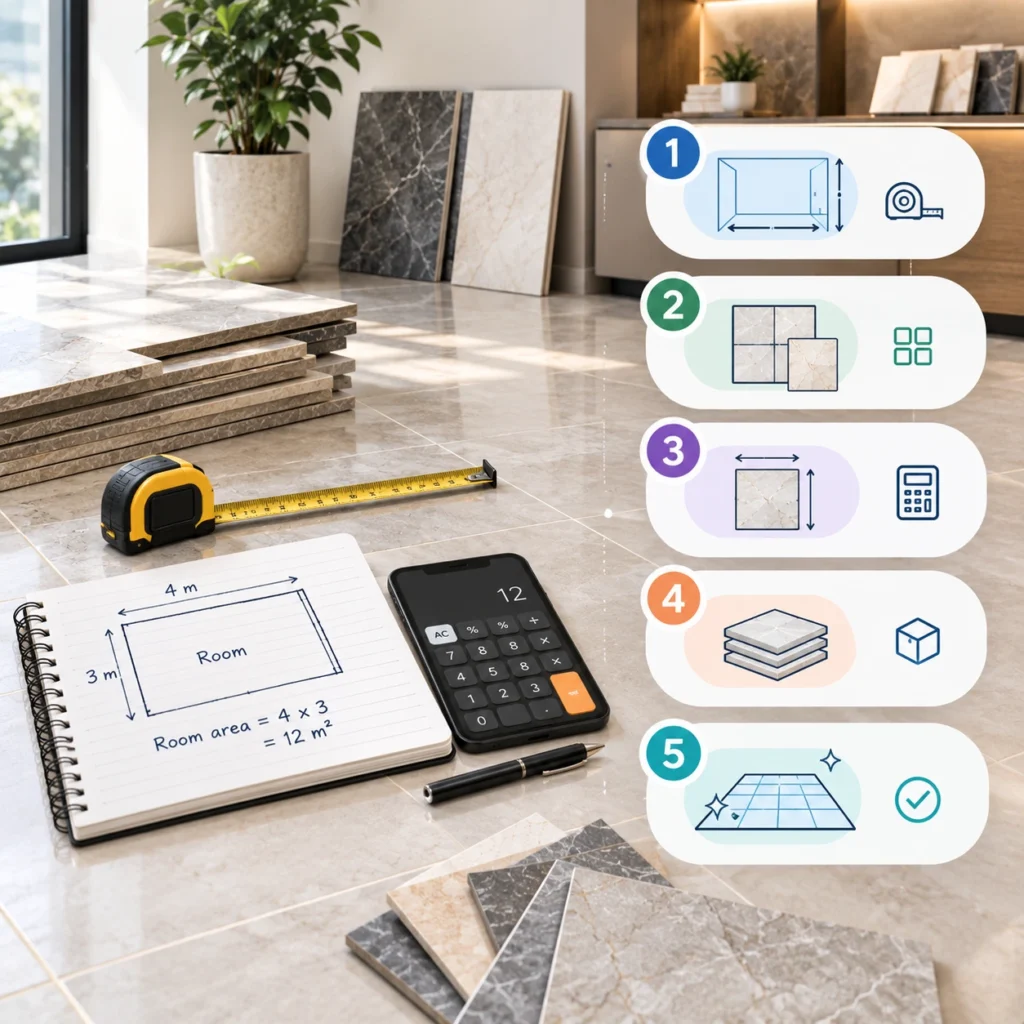
Quick answer: room area divided by tile area, plus roughly 10 percent for cuts and breakage, then rounded up to full boxes. A 120 square foot floor with 2 square foot tiles works out to 60 tiles, or 66 with the cushion.
How to Measure a Room for Tile Calculation
Start on the floor, tape in hand, and write every number down as you go. Your memory won’t survive the drive to the showroom.
Rectangles and Odd Shapes
For a plain rectangle, multiply length by width. Twelve feet by ten feet gives 120 square feet.
Older houses are the problem. Walls drift out of parallel, so measure both ends of each side and take the longer figure. A few inches over beats a few inches short.
L shaped kitchen? Split it into two rectangles, measure each, add them up. Alcoves and bays work the same way.
What to Subtract and What to Keep
A kitchen island or the base of a freestanding tub can come off the total, since tile never goes under them. A toilet or a floor vent can’t. You’ll be cutting around those, and that’s precisely what the waste allowance is for. Doorways swing the other way. If the tile runs through the threshold, add that strip.
How to Calculate Tile Coverage Area
Now the other half of the division. It sounds trivial and mostly is, with one trap hiding in the spec sheet.
Multiply the tile’s length by its width. A 12 by 24 inch tile is 288 square inches, or 2 square feet once you divide by 144. In metric, 300 by 600 millimeters covers 0.18 square meters. Square tiles are the easy case: 12 by 12 inches is exactly one square foot, so tile count and square footage match.
Check the Actual Tile Dimensions
Nominal sizes lie a little. A tile sold as 24 by 24 inches might measure closer to 23.5, especially if it’s rectified. Across a big floor, that’s a lot of lost coverage. Trust the spec sheet, not the shelf label.
Do Grout Joints Count?
Barely, when the joints are thin, around 2 millimeters. Ignore them. Mosaics and wide joints are different. Add the joint to each side of the tile before you multiply, or your count will run a bit high.
How to Calculate the Number of Tiles Needed, Including Waste
Room area divided by tile area gives the base count. For our 120 square foot floor and 2 square foot tile, that’s 60. Don’t order 60.
That figure assumes every cut lands and nothing chips. Installers will laugh at that. How much cushion you need depends mostly on the layout.
Waste Allowance by Layout
These are rules of thumb, so check the final number with whoever’s laying the floor.
| Layout | Typical allowance |
| Straight lay in a standard room | About 10 percent |
| Diagonal pattern | About 15 percent |
| Herringbone or chevron | 15 to 20 percent |
| Large format tiles, over 24 inches | 10 to 15 percent |
| Lots of corners, angles or niches | Add roughly 5 percent on top |
Forums love to say 5 percent is enough. Skip that advice. It sounds thrifty right up until the last row needs six tiles and you’ve got four.
Ten percent of 60 is 6 more. Working number: 66.
How to Calculate the Number of Tile Boxes Required
Nobody buys tile by the dozen, so convert. Check the coverage on the box label. Say a box holds 8 tiles and covers 16 square feet. Then 66 divided by 8 gives 8.25 boxes.
Round up to 9. Always up.
That leaves you 72 tiles, six over the minimum, and you should keep every one of them. Ranges get discontinued, and matching a pattern five years later is miserable.
Example: How Many Tiles Are Needed for a 10 × 12 Foot Room?
All of it together, on one floor.
| Step | Calculation | Result |
| Room area | 10 feet by 12 feet | 120 square feet |
| Tile area | 12 inches by 24 inches | 2 square feet |
| Base count | 120 divided by 2 | 60 tiles |
| Add 10 percent | 60 times 1.10 | 66 tiles |
| Boxes at 8 tiles each | 66 divided by 8, rounded up | 9 boxes |
Metric lands in the same place. A 3 by 3.6 meter room is 10.8 square meters, divided by 0.18 that’s 60 tiles, and 66 once waste is in.
How to Calculate Tiles Required for Walls
Backsplash, shower wall, feature wall: same logic, different obstacles. You’ll subtract windows and niches instead of islands, and there’s trim to think about.
Wall Area and Tile Count
Work out width times height for each wall, then take off windows and doors. Say a shower wall is 8 feet high and 6 feet wide. That’s 48 square feet, and a 3 by 2 foot window removes 6, leaving 42.
Subway tiles at 3 by 6 inches cover 0.125 square feet each, so you need 336. Add 10 percent and order 370. Small tile means lots of pieces, so check the coverage per carton. The carton’s what you’re actually buying.
Trim Pieces
Bullnose edges, corner pieces and skirting tiles usually sell separately, and you count them along the edge in linear feet, not by area. People forget these constantly.
Common Tile Calculation Mistakes to Avoid
Most shortages come from a short list of mistakes. Mixed batches hurt the most, since you can’t fix a shade mismatch by ordering more tile.
Mixed Batches
Different production runs can vary in shade, even inside one range. Buy everything in a single order and compare the lot numbers on every box before you open one. Two numbers don’t match? Say so before the first tile goes down. After is too late.
Other Common Slips
- Rounding down to the nearest box
- Reading the size from a photo instead of the spec sheet
- Switching from a straight layout to diagonal after the math is done, which quietly wrecks your numbers
- Skipping the spare box
Tips for Measuring a Room Accurately Before Buying Tiles
Sketch the room on paper and write every measurement on it. Takes two minutes. Then photograph the sketch. Three weeks later, standing in a showroom and unable to remember whether the bathroom was 7 feet or 8, that photo saves you a return trip. It’s the cheapest insurance in the whole process.
Using an Online Calculator Without Getting Burned
A decent calculator runs every step above for you. You enter room size, tile size and layout, and out come tiles and boxes. That’s why more retailers are adding interactive tile calculators to product pages.
Three Checks Before You Trust the Result
Does it add waste on its own? Does it round up to full boxes? Does it know about your layout? One that quietly uses 5 percent for a herringbone floor will leave you short.
Do your own sum once as a cross check. If you’re more than a box apart, somebody’s wrong.
How Tile Retailers Can Reduce Incorrect Quantity Orders
If you sell tile, count how many steps your buyer has to get right. Coverage per box, waste, rounding, layout. Every one is a chance for a short order or a return, and those eat into freight, restocking and goodwill.
The fix is mostly presentation. Put coverage next to the price, round to whole boxes automatically, and let buyers add their own waste percentage. Most wrong quantity orders disappear before they reach the cart.
Selling tile online and tired of short orders and returns? Book a consultation and we’ll look at how coverage tools could fit your catalog.
FAQs
1. How many tiles do I need for a 10 by 12 foot room?
That’s 120 square feet. With 12 by 12 inch tiles you need 120, plus about 10 percent for waste, so 132. Bigger tiles mean fewer pieces but the same area plus allowance.
2. How much extra tile should I buy?
Roughly 10 percent for a straight layout, 15 for diagonal, up to 20 for herringbone. Small or awkward rooms may need more.
3. How do I calculate tiles in square meters?
Multiply room length by width in meters, divide by one tile’s area in square meters, add waste, round up to full boxes.
4. Does grout spacing change how many tiles I need?
Slightly. With large tiles and thin joints, not enough to matter. With mosaics or wide joints it can shift the count.
5. Should I round up to the next box?
Yes. You can’t buy half a box, and spares come in handy for repairs later.