
Most tile websites lose sales at the same moment. A shopper likes a product, checks the price per square foot, then stalls because they have no idea how many boxes to buy. So they leave to find a calculator somewhere else, and plenty of them never come back.
An interactive tile calculator closes that gap on the page where the decision happens. Not as a gimmick. As a working part of the buying path that affects order size, return rates, and lead quality all at once.
Here is what actually drives the lift, and what to watch out for.
Why Tile Product Pages Lose Conversions Without Tile Calculator
It usually isn’t price.
Tile is one of the few product categories where the customer cannot complete the purchase without doing arithmetic first. Square footage. Tile size. Grout joints. A waste allowance for cuts and breakage. Miss any of it and they either run short mid job or overspend by hundreds of dollars.
That’s a high stakes calculation to hand someone with no tools.
Watch session recordings on a tile product page and you’ll see the pattern repeat. Shoppers scroll to the specs, hover over the quantity field, open a new tab, and disappear. The intent was there. The confidence wasn’t.
Our team sees the same behavior across ecommerce builds for tile brands, and it holds true whether the visitor is a homeowner planning a bathroom or a contractor pricing three units in a townhouse project.
How Interactive Tile Calculators Improve Website Conversions
A calculator does something more useful than answer a question. It moves the shopper from browsing to planning, and planning behavior converts far better than browsing behavior.
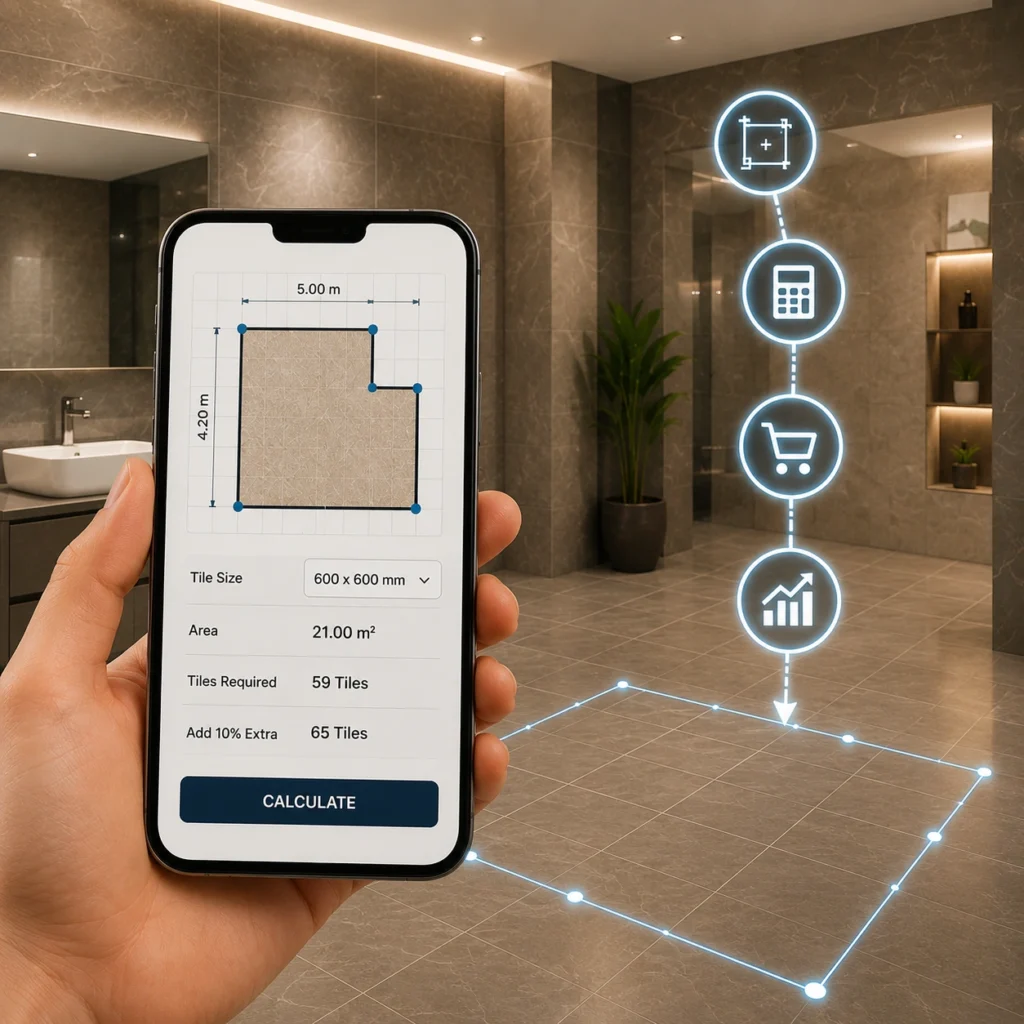
Tile IT Solutions builds these as part of its tile calculator solutions for manufacturers, distributors, and dealers, configured against a real product catalog rather than dropped in as a generic widget. The coverage tool takes room length and width plus tile size, handles square, rectangular, and hexagonal formats, and returns both the bare minimum and the recommended quantity once a waste factor is applied. Across client implementations, that shift shows up as roughly a 35 percent increase in purchase confidence.
Confidence is the metric that matters. A confident buyer adds to cart. An uncertain one comparison shops.
5 Ways Interactive Tile Calculators Increase Website Conversions
The gains don’t come from one place. They stack, and some of them show up in margin rather than conversion rate.
1. Remove Purchase Friction with Instant Tile Calculations
This is the obvious one, and it’s still the biggest. Instant feedback on quantity removes the single largest friction point on a tile product page. No tab switching, no third party calculator, no mental arithmetic while holding a credit card.
2. Increase Average Order Value with Waste Factor Calculations
Most shoppers underestimate waste. Left alone, they order exactly the square footage of the room and come up short.
A calculator that surfaces a 10 to 15 percent waste allowance, with a clear explanation of why diagonal layouts and rooms with lots of corners need more, does two things. It protects the customer from a shortage, and it corrects an order that was going to be too small. Higher average order value follows naturally, and it’s honest rather than manipulative, which matters for repeat business.
Worth noting: dye lot and shade variation makes this more urgent in tile than in almost any other category. Reordering three boxes six weeks later often means a visible mismatch. Customers who learn that upfront order correctly the first time.
3. Improve Cross-Selling with Grout and Accessory Recommendations
Grout is the classic miss. Customers underestimate it constantly, then call support asking how many pounds they need.
A grout calculator that works from tile size, joint width, and coverage area, and accounts for sanded, unsanded, and epoxy types, turns a support ticket into an add to cart. Same logic applies to spacers, trim pieces, membranes, and thinset. The attach rate on these is usually poor for one reason: nobody told the shopper they needed them.
4. Generate Better Sales Leads Using Calculator Data
A visitor who enters room dimensions and a tile selection has told you far more than any form fill would. Project size, product interest, and rough budget, all in one interaction.
Push that into the CRM and the sales team stops cold calling and starts following up on projects. Tile IT Solutions wires this into existing systems through its ERP and CRM integration solutions, so the estimate and the lead land in the same place your sales pipeline already lives.
5. Reduce Returns by Improving Order Accuracy
Wrong quantity is one of the most common reasons tile gets sent back. Returns in this category are brutal on margin. Freight is expensive, breakage during return shipping is normal, and restocking partial lots is a headache for the warehouse team.
Accurate estimating at the point of purchase reduces that volume directly. The conversion rate story gets the attention, but the returns story is often where the money is.
Why Tile Dealers and Distributors Need Interactive Tile Calculators
Most articles on this topic assume a homeowner is doing the clicking. In the tile trade, that’s frequently wrong.
Dealers use calculators too. So do contractors and designers pricing jobs for clients, often standing in a half finished bathroom on a phone.
That changes the requirements:
- Multi room and multi surface calculation, not just one rectangle
- Tiered pricing that reflects the dealer’s actual price level, not retail
- A printable or shareable estimate the dealer can hand to their customer
- Live stock visibility so the estimate doesn’t promise material that isn’t there
The last one gets skipped and shouldn’t. A calculator that recommends 47 boxes when 30 are available across your warehouses creates a worse experience than no calculator at all. Tying the tool into a B2B dealer management portal and connected inventory management solutions keeps the estimate grounded in what you can actually ship.
Real-World Example of a Tile Calculator Improving Sales
A distributor selling porcelain plank tile adds a coverage calculator to product pages. A contractor arrives from search, needs material for four identical apartment bathrooms, and enters the dimensions once.
The tool returns per room and total quantities, adds a 12 percent waste allowance because the layout is offset, flags the grout requirement, and confirms the lot has enough stock for the full run. He saves the estimate, emails it to himself, and orders the next morning.
Without the calculator, that same contractor gets a price per square foot and a phone number. Some of those calls happen. Most don’t.
What an Interactive Tile Calculator Cannot Solve
Honest answer: quite a lot.
They won’t rescue a slow product page, thin product photography, or a checkout that asks for an account before showing shipping cost. If the fundamentals of your store are weak, a calculator adds a nice feature to a page that still doesn’t convert.
They also won’t overcome missing product data. A coverage calculator needs accurate tile dimensions, pieces per box, and coverage per box for every SKU. Catalogs with gaps in those fields will produce wrong answers, and a wrong answer damages trust faster than no tool at all.
And a calculator alone rarely settles the aesthetic question. Buyers want to know how the tile looks in their room, which is a different problem solved by 3D and AR product visualization solutions. Calculators handle how much. Visualization handles whether they’ll like it. Sites that run both together see the strongest results, with return rates dropping around 40 percent once visualization is in place.
Common Tile Calculator Implementation Mistakes to Avoid
A few patterns show up repeatedly in audits.
- Gating results behind an email form: Tempting, and usually a mistake. Shoppers who hit a wall mid calculation bounce, and you lose the sale to capture a lead you no longer need. Show the number first, then offer to save or email the estimate.
- Burying it on a separate page: A calculator hidden under a resources menu gets almost no traffic. It belongs on the product page, near the quantity field, where the hesitation actually happens.
- Ignoring mobile: Contractors and designers use these on site, one handed, with dusty screens. Small tap targets and desktop layouts kill usage.
- Skipping the explanation: A number with no reasoning invites doubt. Show the breakdown: area, tiles per box, waste allowance, total.
- Set and forget: Usage data tells you which products get calculated most and where people drop off mid flow. That’s product mix intelligence and it’s sitting there unused in most implementations.
KPIs to Measure the Success of Your Interactive Tile Calculator
Conversion rate alone won’t tell you much, because calculator users are a self selected high intent group. Track the comparison instead.
|
Metric |
What it tells you |
|
Calculator engagement rate |
Whether shoppers are finding and using it |
|
Conversion rate, users vs non users |
The real lift, isolated |
|
Average order value, users vs non users |
Whether waste factor guidance is working |
|
Add to cart rate on grout and accessories |
Attach rate improvement |
|
Return rate for wrong quantity |
Margin impact over 60 to 90 days |
|
Completed calculations per session |
Whether the flow is too complex |
Give it a full quarter before judging returns data. Tile projects have long lead times between purchase and installation, and returns lag accordingly.
SEO Benefits of Interactive Tile Calculator Pages
Calculator pages earn links and rankings on their own. Searches like tile coverage calculator and how much grout do I need carry real volume in the US and UK markets, and they attract visitors at the exact moment a purchase decision is forming.
They also perform well in AI generated answers, since the underlying question has a direct, factual response. Publishing the method alongside the tool, with imperial and metric units both supported, gives you a shot at being the source that gets cited.
That’s not the primary reason to build one. It’s a reasonable bonus.
How To Get Started With An Interactive Tile Calculator
Pick your highest traffic product category and add coverage plus grout calculation to those product pages first. Measure for a quarter. Expand from there.
Configuration against your real catalog and pricing matters more than the interface. A beautiful calculator returning wrong numbers is worse than nothing, and fixing catalog data is usually the unglamorous work that determines whether any of this pays off.
Turn calculation friction into completed orders.
Tile IT Solutions has implemented calculator tools for 30 plus tile companies, configured against real catalogs, pricing, and warehouse stock. Coverage, grout, layout, and cost estimating, embedded where your customers actually hesitate.
FAQs
1. Do tile calculators actually increase conversion rates?
Yes, mainly by removing the quantity guesswork that stalls checkout. Client implementations show around a 35 percent increase in purchase confidence.
2. What should a tile calculator include at minimum?
Coverage by room dimensions and tile size, a waste factor between 10 and 15 percent, and grout quantity. Cost estimating is a useful addition.
3. Should I require an email before showing results?
No. Gating results loses more sales than the leads are worth. Show the number, then offer to save or email the estimate.
4. Why is waste factor so important for tile?
Cuts and breakage consume material, and shade variation between lots makes reordering risky. A 10 to 15 percent allowance prevents shortages.
5. Can calculators work for B2B dealers, not just retail buyers?
Yes. Dealer versions need tiered pricing, multi room calculation, shareable estimates, and live stock visibility.
6. How long before results show up?
Engagement and conversion data within a few weeks. Return rate impact takes 60 to 90 days because installation lags purchase.
7. Do calculators help SEO?
They do. Coverage and grout queries drive high intent search traffic, and tool pages tend to attract natural links.