Pick the wrong platform and one porcelain series can end up as forty disconnected product pages. That’s the real risk sitting inside the Shopify Plus vs Magento debate for tile brands. Sizes, finishes, colors, thicknesses and shade lots stack up fast, and each platform models them very differently.
We build and manage stores on both, so this comparison sticks to what actually happens with heavy tile catalogs. If you’re planning a full tile ecommerce solution, start with the data model below.
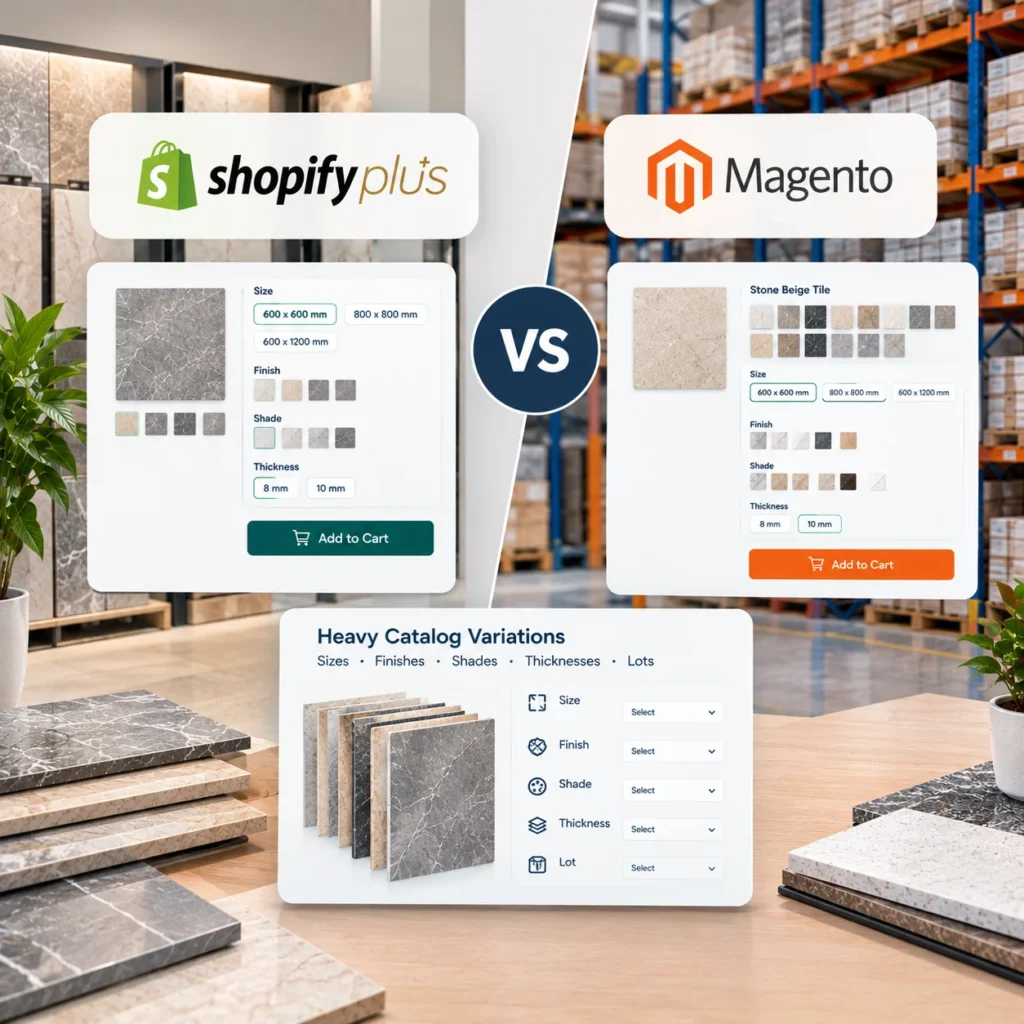
Shopify Plus vs Magento for Tile Catalog Variations: Quick Comparison
Magento (now sold as Adobe Commerce, with a free Open Source edition) handles deep, attribute heavy tile catalogs more natively. Shopify Plus is quicker to launch and usually cheaper to maintain, and its variant ceiling jumped in late 2025. It still caps every product at three options, though.
So here’s the rule of thumb. Tiles varying across four or more dimensions, plus a big dealer channel? Magento usually wins. A tighter range where speed to market matters most? Shopify Plus is the smarter bet.
Why Tile Product Catalogs Are More Complex Than Standard Ecommerce
Apparel has size and color. Tile has a lot more going on.
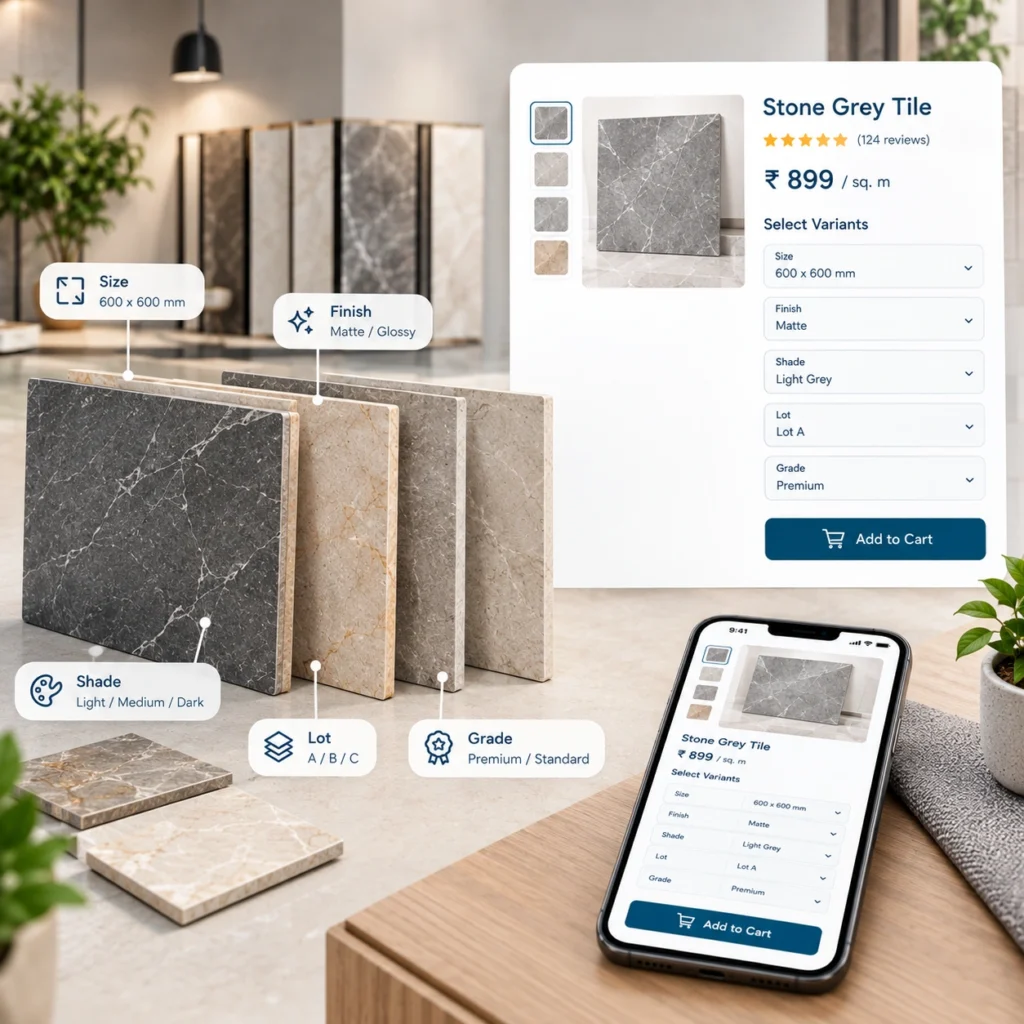
Take one porcelain series. Four sizes (300×600, 600×600, 600×1200, 800×800). Five colors. Three finishes: matt, polished and structured. Two thicknesses, 9mm for interiors and 20mm for outdoor pavers. That’s 120 sellable combinations across four dimensions, and you haven’t touched bullnose trims or mosaic sheets yet.
Then come the specs buyers filter by but that don’t belong in a variant at all: PEI rating, slip resistance, rectified edges, water absorption, box coverage.
Shade lots are trickier still. They change with every kiln run, so they aren’t a product option. They’re inventory. Platforms that blur that line create picking errors in the warehouse, and a mismatched shade on a floor is the kind of complaint nobody forgets.
Start any platform decision from this data, not from a theme demo.
How Shopify Plus Handles Complex Tile Product Variations
Shopify has closed a lot of the gap in the last year. Three things decide how well it copes with a real tile range.
1. More Variants, Same Three Options
On October 15, 2025, Shopify raised the variant limit to 2,048 per product, up from the long standing cap of 100. Good news for big series.
The option count didn’t move. You still get three option types per product, so in the example above one dimension has to live somewhere else. Most teams either merge two into a single value (“600×1200 / 20mm”) or split thickness into separate products. Both work. Neither is pretty, and merged values make filtering clumsy.
Worth checking too: older apps built on Shopify’s legacy REST API can misbehave once a product passes 100 variants. Test your reviews, search and ERP connector apps before you load a full series.
2. Combined Listings
This is the workaround that actually helps tile brands, and it’s available only on Shopify Plus. You create each color as its own product, with its own images and URL, then group them under one parent page.
Limits to know:
- A parent can hold up to 60 child products and 2,000 variants across them
- The parent still gets three options
- Combined listings sell through the Online Store channel only, not POS or third party channels
For a showroom brand running Shopify POS at the counter, that last point matters more than it looks.
3. Specs in Metafields
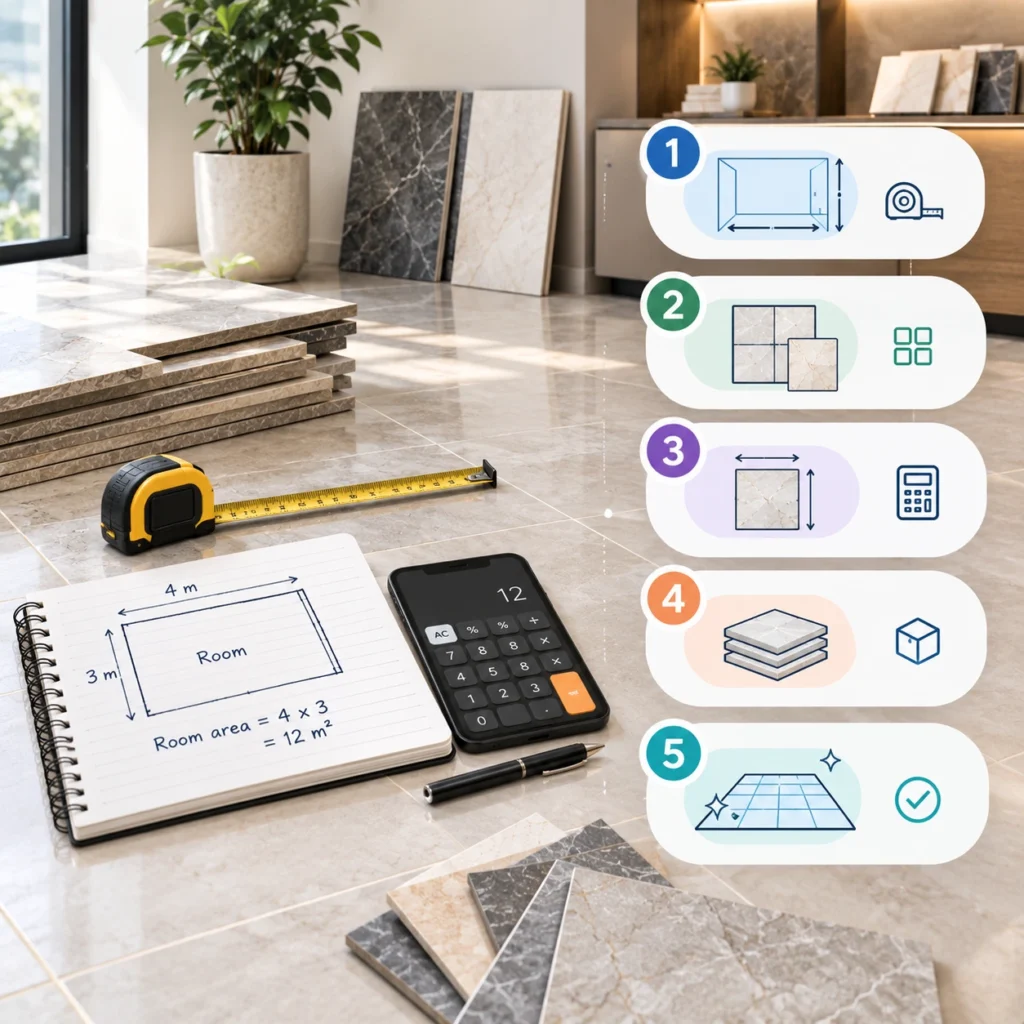
PEI class, slip rating and coverage per box go into metafields, and Shopify’s filtering can surface them as storefront filters. It works fine. It just takes planning up front, since metafields don’t inherit across products the way attribute sets do. And because tile sells by the box while buyers think in square meters, you’ll usually want tile coverage calculators layered on top.
If Shopify is your direction, our Shopify store management services cover exactly this catalog setup.
How Magento Handles Complex Tile Product Variations
Magento was built around attributes. It shows.
1. Configurable Products and Attribute Sets
Adobe describes a configurable product as a parent made up of multiple simple products, where the buyer picks options to reach one specific variation. For tile, every child is a real SKU with its own stock, price and weight per box. You aren’t boxed in at three configurable attributes either, so size, color, finish and thickness can all be proper selectable options.
Attribute sets are the quiet advantage. Floor tiles, mosaics and trims each get their own set of fields, so a trim piece never shows an empty “PEI rating” box. Layered navigation turns those attributes straight into filters.
2. Dealer Pricing and Lots
Adobe Commerce’s B2B features (company accounts, shared catalogs with account specific pricing, quick order by SKU, requisition lists) map neatly onto how distributors already sell. That’s a big reason larger tile operations stay on Magento, and it pairs well with a dedicated B2B dealer management solution when dealer workflows get complex.
Shade lot tracking? Still not native. Magento just gives you more room to build it properly.
3. The Honest Downside
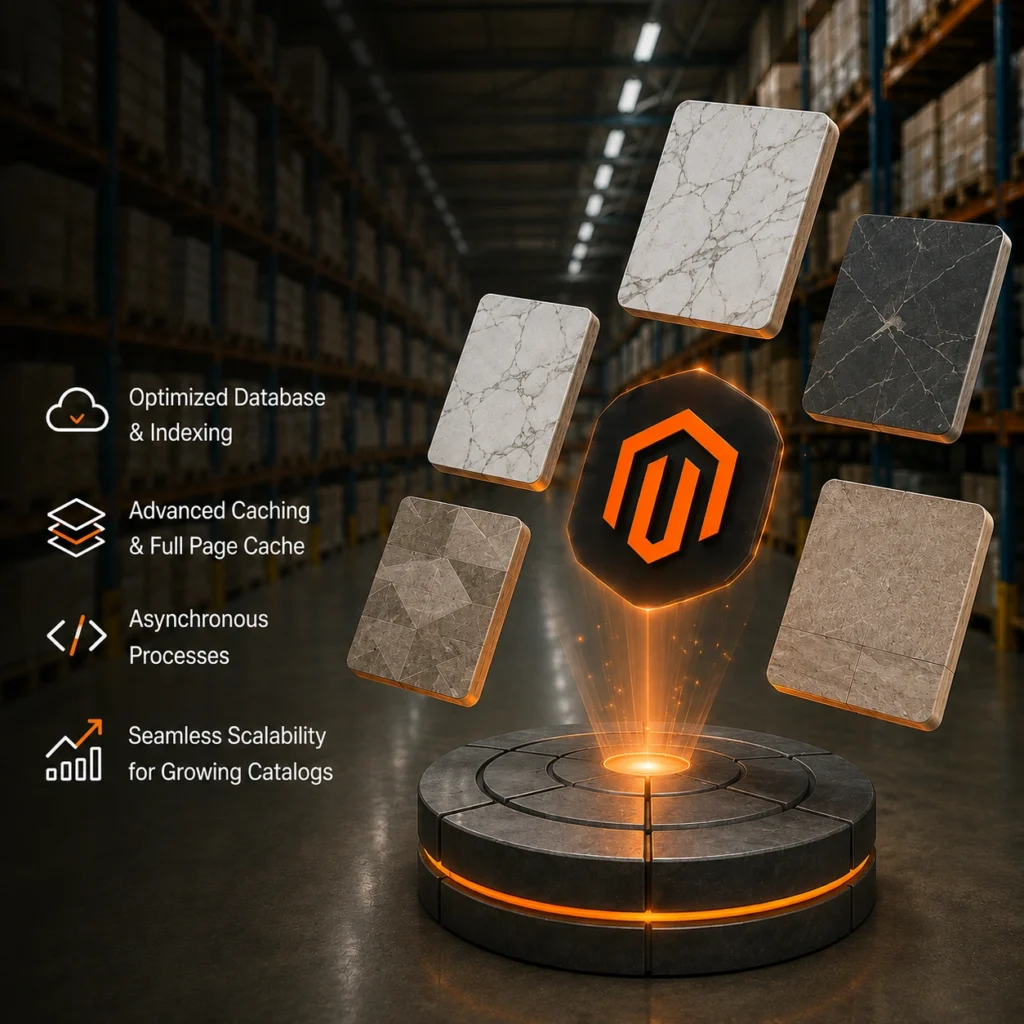
It’s a heavier machine. You need hosting, security patching, version upgrades and developers who know the platform well. Reindexing slows down as configurable products pile up thousands of children, so catalog architecture matters from day one. That upkeep is exactly what our Magento store management services handle.
Must Read: How Magento Handles Large Flooring and Tile Product Catalogs
Shopify Plus vs Magento for Tile Ecommerce: Feature Comparison
| Factor | Shopify Plus | Magento (Adobe Commerce) |
| Options per product | 3 | Not capped at three |
| Variants per product | Up to 2,048 | No fixed cap; performance sets the limit |
| Colors on one page | Combined listings (Plus only, Online Store only) | Configurable products |
| Tile specs | Metafields | Native attributes and attribute sets |
| Dealer pricing | Built in B2B on Plus | Adobe Commerce B2B module |
| Shade lots | Needs an app or ERP sync | Custom build or ERP sync |
| Hosting and upkeep | Fully hosted by Shopify | Self hosted or Adobe cloud |
| Launch speed | Faster | Slower, more custom |
Shopify Plus vs Magento: Which Is Better for Your Tile Business?
A retail brand selling 800 SKUs direct to homeowners, mostly in two finishes? Shopify Plus. You’ll launch in weeks rather than months, and combined listings handle the color problem.
A manufacturer with 15,000 SKUs, matching trims for every series and dealer price lists that differ by account is a different story. That’s Magento territory, almost every time.
Somewhere in between, it comes down to who’s placing orders. Mostly homeowners and designers leans Shopify. Mostly contractors and dealers reordering by SKU leans Magento.
Why Your Ecommerce Platform Should Not Manage Tile Inventory Alone
The storefront shouldn’t be where your product truth lives.
Shade lot is the classic example. Neither platform tracks it well on its own, and it shouldn’t have to. The fix sits upstream: your warehouse system holds lot, caliber and stock by location, and the store reads from it. Our inventory management solution and ERP integration solution exist for this reason. Get that sync right and either platform looks far better than it does in isolation.
It’s also why our catalog builds are designed to handle 50,000+ SKUs with variations for size, finish, color, lot and thickness, whichever storefront sits on top.
How to Choose Between Shopify Plus and Magento for a Tile Catalog
Answer three questions honestly.
- How many true variant dimensions does your biggest series have? Four or more pushes you toward Magento.
- Who buys? Dealer heavy channels favor Magento’s B2B depth.
- Who’ll maintain it? No in house developer means Shopify Plus is far easier to live with.
Two or three answers pointing the same way usually settles it.
Not sure which platform fits your catalog? Send us one of your most complicated series, with every size, finish and thickness, and we’ll show you how it would look on Shopify Plus and on Magento before you commit to either. Book a catalog consultation with the Tile IT Solutions team.
FAQs
1. Can Shopify Plus handle more than 100 variants per tile product?
Yes. Since October 2025, Shopify supports up to 2,048 variants per product. You’re still limited to three options, so tile series with four dimensions need merged values or combined listings.
2. Is Magento better than Shopify Plus for tile distributors?
Usually, yes. Account specific pricing, shared catalogs and quick order by SKU are more mature in Adobe Commerce. Shopify Plus B2B covers simpler dealer setups well.
3. Should shade lots be set up as variants?
No. Shade lots are inventory, not product options. Keep them in your warehouse or ERP system and sync availability to the store.
4. Which platform costs less to run?
Shopify Plus, in most cases. Magento Open Source has no license fee, but hosting, upgrades and developer time add up.
5. Can we switch platforms later?
You can, but it means rebuilding the catalog structure. Settle your data model first and the move gets much easier.