
Most of the challenges ceramic tile dealers face don’t start with demand. Ask a dealer what went wrong last month and you’ll hear about a bathroom job that came up two boxes short. A contractor who swears the new batch doesn’t match. A quote built from last quarter’s price sheet.
Those aren’t really sales problems. They’re information problems.
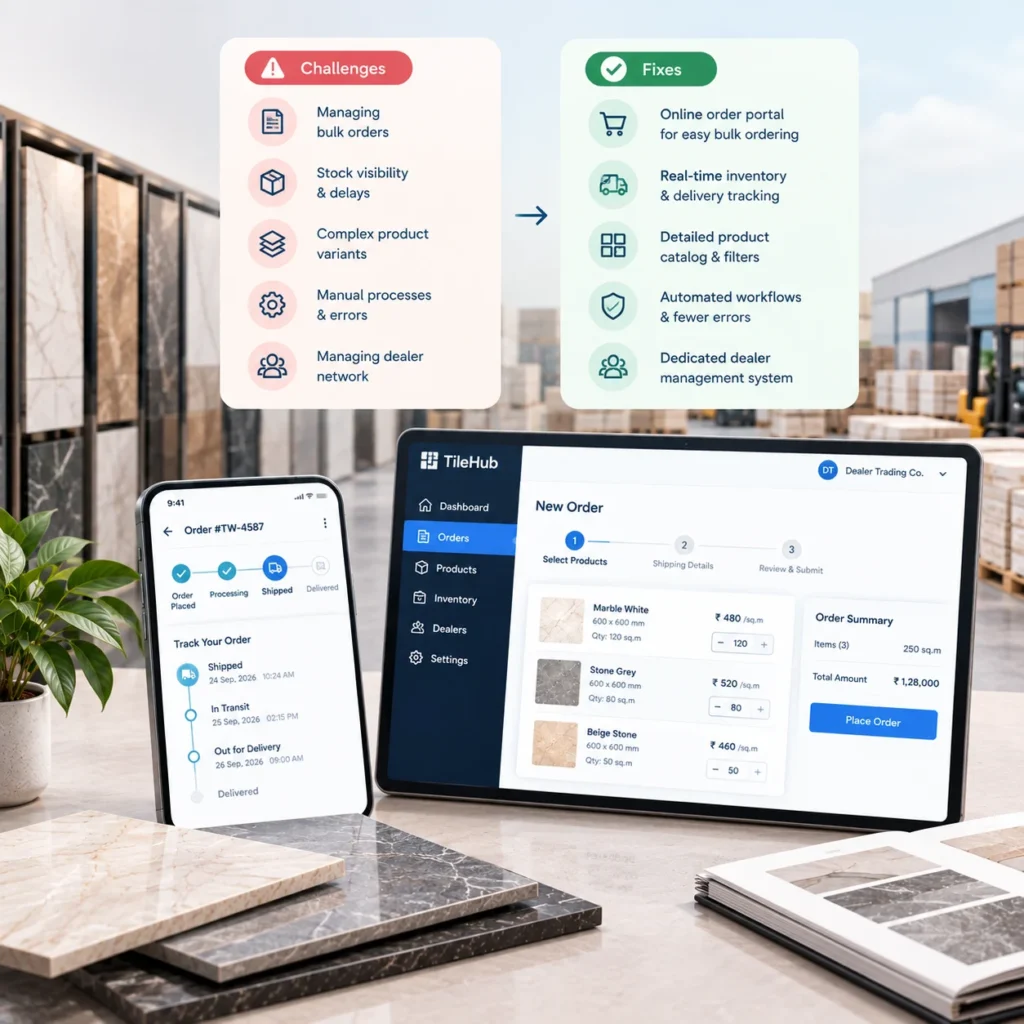
Stock levels sit in one spreadsheet, dealer pricing in another, and order updates arrive by phone or WhatsApp. That’s the gap a B2B dealer management portal solution is built to close, putting live inventory, tiered pricing, order tracking, and invoices in one place for every dealer account. Below are the ten problems that come up most, what each one costs you, and which technology fixes them. We’ll also be honest about where software only gets you partway.
The 10 Biggest Problems Tile Dealers Deal With
The list roughly follows how problems travel through a dealership, from the warehouse shelf to the showroom counter to the job site. Your top three might look different, and that’s fine.
1. Shade and Dye Lot Mismatches
A homeowner buys 300 square feet in spring. In summer she’s back for 60 more to finish the hallway. Same SKU, same name on the box, but a different lot, and the shade is visibly off once it’s on the floor.
Now you’re dealing with a return, maybe a tear out, and a customer telling friends your tile “didn’t match.”
The fix is lot tracking at the inventory level, not on sticky notes. A proper inventory management solution records the lot number for every tile in stock, so counter staff can see instantly whether enough of one lot exists to cover the full job. If it doesn’t, they know before the sale, not after the install. Reserving stock by lot at order time is the part most dealers skip. Don’t.
2. Customers Buying the Wrong Quantity
Coverage math sounds simple until someone forgets the waste factor. Common mistakes we see:
- Measuring floor area but ignoring cuts around vanities, doorways, and closets
- Using a straight lay waste allowance for a herringbone or diagonal pattern, which needs noticeably more
- Converting between square feet, pieces, and boxes by hand
- Forgetting grout and trim entirely
Every one of these ends in a second trip, and possibly a different dye lot (see problem one). Online tile coverage and grout calculators help buyers get the number right before checkout, and the same tool at the counter keeps your staff consistent. Fewer short orders. Fewer returns.
3. No Clear View of Stock, Yours or Your Supplier’s
Picture it. A contractor calls at 7:40 in the morning needing 40 boxes by Thursday. Your rep says “let me check,” calls the back warehouse, then emails the distributor, then waits.
By the time the answer comes back, the contractor has already called someone else.
Two things solve this. Internally, a single dashboard showing stock across every warehouse and showroom location. Externally, access to your supplier’s live inventory. More distributors now run a B2B dealer portal that shows real time stock by warehouse along with expected restock dates, so you can answer “yes” or “not until next week” while the contractor is still on the phone. If your main supplier offers one, use it. If they don’t, ask why.
4. Dead Stock Eating Warehouse Space
Trends move faster than tile does. A finish that sold well two years ago can sit for months once buyers shift toward warmer tones or bigger formats, and discontinued lines are worse.
Demand forecasting helps here by flagging slow movers early, while you still have time to discount, bundle, or return them. It won’t save a bad buying decision already made.
One caveat: forecasting is only as good as your sales history. With less than a year of clean data, treat the predictions as a starting point.
5. Slow, Manual Quotes
Contractors often collect quotes from several dealers, and the fastest accurate quote wins a lot of those jobs. If your team builds every quote in a spreadsheet, checks stock separately, and hunts for the current contractor price, you’re losing on speed alone.
Worse, spreadsheet quotes drift. Last quarter’s price file sneaks in. Somebody forgets the volume discount. Quoting that pulls pricing, customer tier, and stock from one source fixes both problems at once, and it’s usually a byproduct of fixing problem eight.
6. Shoppers Who Can’t Picture the Finished Room
Your showroom can only display a fraction of what you can order. So buyers take samples home, come back, take different samples, and come back again. Some never decide at all.
Tile visualization tools with AR and 3D rendering let shoppers see a tile on their own floor or wall before they buy. Manufacturers are clearly betting on this too. Floor Covering News reported that major tile brands are pushing visualizers to their retail partners as a way to cut guesswork and shorten the sales cycle.
Is it worth it for a small showroom? Often, yes, especially for backsplash and bathroom projects where style anxiety is high.
7. Buyers Research Online Before They Walk In
Watch for this: if your catalog isn’t online with real specs, many buyers never make it to your showroom.
Homeowners and designers compare finishes, sizes, PEI ratings, and prices on their phones long before they visit. A dealer with a thin website, or none, simply isn’t part of that shortlist. An ecommerce and catalog platform with proper product data and sample ordering turns that research into foot traffic. Samples matter more than people think. They’re usually the first commitment a buyer makes.
Being found is the other half, which is where focused digital marketing for tile businesses comes in.
8. Disconnected Systems and Double Entry
This one quietly causes half the others.
Orders confirmed over WhatsApp. Stock kept in a spreadsheet. Invoices in accounting software that talks to nothing. Every time someone retypes an order, there’s a chance for a wrong SKU, a wrong quantity, or a wrong price.
ERP and CRM integration connects systems like SAP, NetSuite, Salesforce, and your accounting tools so that an order entered once flows everywhere it needs to go. It’s not the flashiest upgrade. Frankly, it’s often the one with the biggest payoff.
9. Breakage, Damage, and Receiving Errors
Tile is heavy, brittle, and shipped by the pallet. Damage happens. The real problem is when nobody catches it at receiving, and the shortage surfaces three weeks later when a customer’s order is being picked.
Barcode scanning at the dock confirms each incoming shipment against what was ordered, and Tile IT Solutions cites a 95 percent reduction in receiving errors on its inventory platform. Regular cycle counts then flag gaps between system stock and physical stock, and help trace whether the cause was damage, theft, or a typo.
10. The Installer Shortage
Here’s where we’ll be straight with you. Software can’t create tile setters.
Floor Daily’s ceramic tile report points out that because ceramic is almost always professionally installed, the shortage of qualified installers hits the category especially hard. Technology helps at the edges only. Accurate quantities, matching lots, and on time deliveries mean the installers you do work with don’t waste days on return trips and callbacks. That makes you the dealer they’d rather work with, which counts for something.
Quick Reference: Challenge vs. Technology
| Challenge | What it costs you | Technology that helps |
| Shade and dye lot mismatches | Returns, tear outs, reputation | Lot tracking in inventory software |
| Wrong quantities | Second trips, mixed lots | Coverage and grout calculators |
| Poor stock visibility | Lost contractor orders | Multi warehouse dashboard, supplier B2B portal |
| Dead stock | Tied up cash and floor space | Demand forecasting |
| Slow quotes | Lost bids | Pricing and stock from one data source |
| Indecisive shoppers | Long sales cycles | AR and 3D visualization |
| Weak online presence | Missed showroom visits | Ecommerce catalog, sample ordering, SEO |
| Disconnected systems | Order errors, wasted hours | ERP and CRM integration |
| Receiving errors | Hidden shortages | Barcode scanning, cycle counts |
| Installer shortage | Delayed jobs | Indirect help through accuracy |
Where Should a Tile Dealer Start?
Not with everything at once. That’s usually how software projects stall.
Start with inventory accuracy. Calculators, portals, visualizers, and online catalogs all depend on stock data being right, and a beautiful visualizer sitting on top of wrong counts just sells tile you don’t have. Once inventory is reliable, connect it to your ERP and accounting. Customer facing tools come after that, because by then they’re pulling from numbers you trust.
The exception? If you’re losing a lot of sales to online competitors right now, a solid catalog site might need to jump the queue. It depends on where the money is leaking.
If you buy from distributors, it’s also worth reading why tile manufacturers are moving to dealer portals, since that shift changes how you’ll check stock and place orders over the next few years. Whatever you build, plan for ongoing platform support from the start. Systems that nobody maintains drift out of sync fast.
Fix the Problem That’s Costing You Most
Shade mismatches, short orders, and lost quotes usually come from the same place: data that doesn’t connect. Tile IT Solutions builds inventory, ERP, ecommerce, and visualization systems made for how tile actually moves. Book a free consultation and we’ll help you find which fix will pay off first for your dealership.
FAQs
1. What is the biggest challenge for ceramic tile dealers?
Inventory accuracy, in most cases. Shade mismatches, short orders, and lost contractor sales all trace back to not knowing exactly what’s in stock, which lot it’s from, and where it sits.
2. How does lot tracking prevent shade variation problems?
It records the lot number of every tile in stock, so staff can check whether one lot covers a full job before selling it. Mixed lots get caught at the counter instead of on the floor.
3. Do small tile dealers need ERP integration?
Not always a full ERP. But if orders, stock, and invoices live in separate tools and someone retypes data between them, connecting those systems usually pays off quickly.
4. Can a tile calculator actually reduce returns?
Yes, when it handles waste factors, patterns, and box conversions correctly. Most quantity errors come from manual math, and a calculator removes that step for both buyers and staff.
5. Is AR tile visualization worth it for a smaller showroom?
Often, yes. It lets shoppers see far more of your catalog than your display space allows, which helps most with bathrooms and backsplashes where buyers hesitate.