Large format porcelain is easy to sell in a showroom and surprisingly hard to sell on a website. In person, a customer can stand next to a 1600 x 3200 mm slab, tilt their head to catch the polish, and ask how it’ll ever get up to a third floor apartment. Online they get a thumbnail, a price per square foot, and a freight number on the very last screen.
Most stalled orders we look at trace back to that gap. To sell large format tiles and slabs online, treat every product page as the rep who isn’t there: it should answer the size and weight questions, show the whole surface, be upfront about delivery cost and know which shade lot the stock sits in. A tile ecommerce solution built around heavy, variable products handles most of the plumbing, but the decisions below matter more than the platform.
What Counts as Large Format Tile and Porcelain Slabs?
Ask an installer and you’ll probably hear “anything with a side of 15 inches or more.” That number stuck because it’s where ANSI A108 asks for a flatter substrate (1/8 inch in 10 feet rather than 1/4 inch), and installers live and die by flatness.
Officially, the line has moved. Floor Trends points out that the ANSI A108 update published in January 2024 defines large format tile as having a facial dimension greater than 23 inches. Slabs and gauged porcelain panels generally start around 1 square meter, roughly 11 square feet.
For a seller this isn’t trivia. It decides what appears under a “large format” filter (people expect 24 x 48 and up, not a 12 x 24 plank) and which products need freight and fabrication notes.
Why Selling Large Format Tiles Online Is Different
The differences are easy to underestimate until a crate turns up with a cracked corner.
| Factor | Standard Tile | Large Format Tile | Slabs and Panels |
| Selling unit | Box | Box, sometimes a full crate | One slab at a time |
| Shipping | Parcel or pallet | Pallet on LTL freight | Crated LTL freight, carried on edge |
| Main buyers | Homeowners, installers | Contractors, designers | Fabricators, designers, builders |
| Transit risk | Low | Edges and corners chip | High, in transit and on site |
The takeaway? Slabs deserve their own page template and checkout logic. We still see 1600 x 3200 slabs listed with the same layout as a box of 12 x 12 ceramic, and it usually shows in the returns.
7 Steps to Sell Large Format Tiles and Slabs Online
These run roughly in the order a buyer works through them: specs, then looks, then money, then logistics.
1. Publish Accurate Tile Dimensions, Thickness and Weight
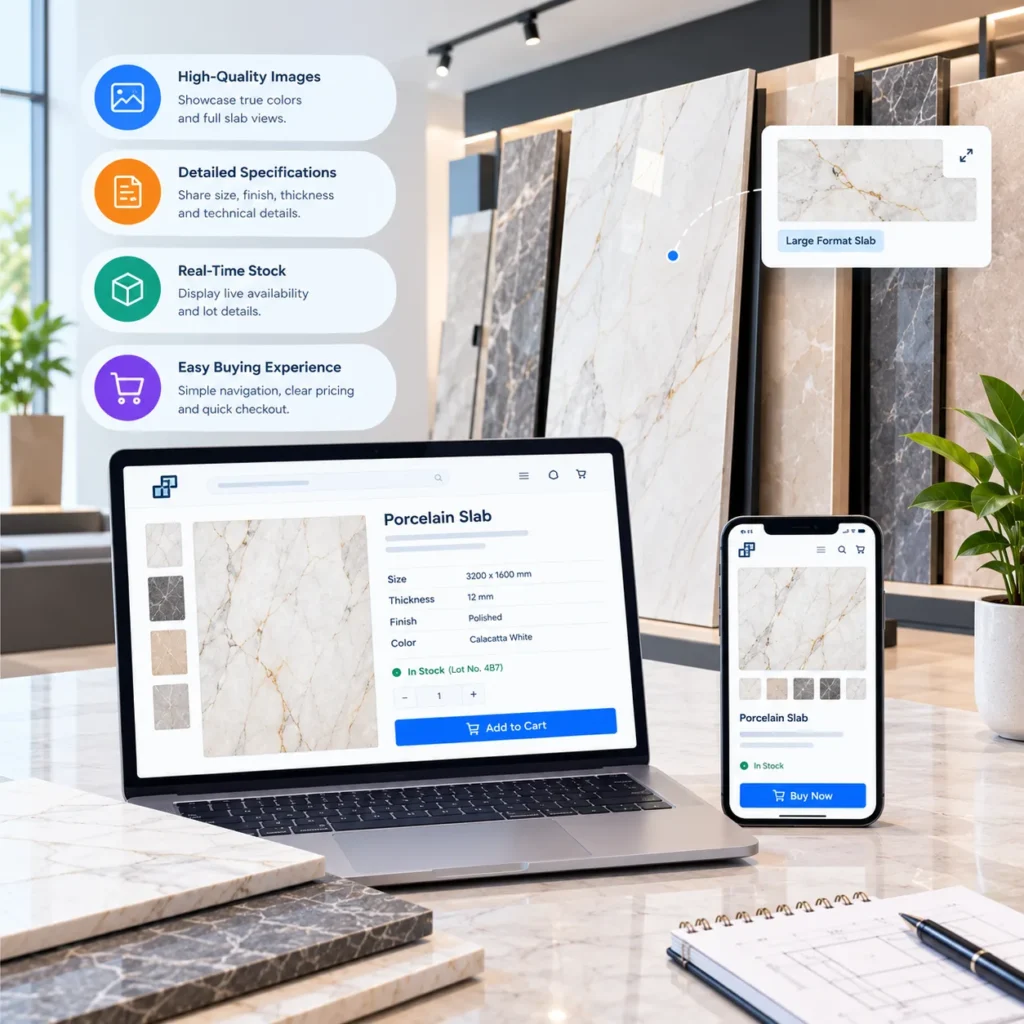
Nominal sizes are the first trap. A tile listed as 24 x 48 is very often 600 x 1200 mm, closer to 23.6 x 47.2 inches, and that gap matters to a contractor laying a 1/16 inch joint down a long hallway.
On every large format listing we’d want to see:
- Actual dimensions in inches and millimeters
- Thickness (a 6 mm panel and a 12 mm slab get cut and set very differently)
- Rectified or pressed edge
- The V1 to V4 shade variation rating, so nobody orders a V4 expecting even color
- Weight per piece, plus pieces, square feet and weight per crate
- Approved uses, from floors and showers to countertops and outdoors
Weight gets left off most often, and it’s the one that wrecks delivery day. Distributor spec sheets put 12 mm porcelain at a little under 6 pounds per square foot, so a single 64 x 128 inch slab is past 330 pounds. That’s a job for two or three people with suction lifters, not a homeowner and a friend.
Big catalogs need sensible structure too, which we covered in our post on managing complex tile product variants.
2. Use Full-Slab Images to Showcase Surface and Veining
Veining is why people buy marble look porcelain, and a 4 x 4 inch crop hides it completely. What looks elegant in a swatch can look busy, or oddly repetitive, across 50 square feet of floor.
The fix is mostly photography. Shoot each slab straight on, full face, under even light. Show bookmatched A and B slabs side by side. A ten second clip under low, angled light explains a lappato finish better than any copy.
Designers also quietly check how many unique faces a series has. With only four on a big floor, the repeats jump out, so put that number on the page. With natural stone, list the actual slab by bundle and slab number, since no two match.
Then a product visualization solution answers the last question, which is nearly always “fine, but what will it look like in my kitchen?”
3. Price Large Format Tiles by Square Foot and Slab
A homeowner thinks in square feet. Your warehouse thinks in boxes and crates. A fabricator only cares about whole slabs, because that’s what gets cut.
One number won’t satisfy all three, but you can pick a main unit and convert the rest. For large format tile we’d usually price per square foot, sell in full boxes and have the cart round up while showing both figures. Something like: you asked for 410 sq ft, that’s 26 boxes at 16 sq ft each, so 416 sq ft. Slabs sell per slab with square footage underneath. Remnants? Per piece, dimensions in the title, done.
Tile calculators on the product page give the buyer that box or slab count instantly, with no email to you.
4. Calculate Large Format Tile Freight Costs Before Checkout
Freight is where a lot of slab orders quietly die. A February 2024 Baymard survey, reported by eMarketer, found 48 percent of respondents had abandoned a checkout because extra costs such as shipping, tax and fees were too high. Now swap a parcel fee for a crated LTL charge.
Freight here is messy, but you can still estimate it early:
- Give an estimate from a postal code on the product page.
- Break out the extras (liftgate, residential delivery, appointments, inside delivery) instead of one mystery number.
- Crating gets its own line.
- Offer depot pickup if you can.
And in the order confirmation, tell buyers to check every crate and write any damage on the delivery receipt before signing. Claims go far more smoothly when that note exists.
5. Use Tile Samples to Support Online Sales
A 12 x 12 cut from a 48 x 48 tile shows color and finish. It can’t show how the veins travel across the whole face, which is half the point of large format, so send the full slab imagery from step 2 along with it.
Timing matters too. Samples ordered Monday and delivered Thursday, with a card linking back to each slab, a freight estimate and a way to reserve stock? That buyer is ready to decide. The same samples ten days later in an unmarked bag land on someone whose interest has gone cold. A small fee credited against the first order keeps the tire kickers out.
6. Manage Tile Inventory by Shade Lot and Batch
Installers have a recurring nightmare: a 1,200 square foot open plan floor delivered from two shade lots, with the difference only visible once the afternoon sun hits it. “In stock: 1,400 sq ft” sounds fine. It isn’t, if that’s really three lots of 500, 500 and 400.
So show stock by lot, and only let the cart accept a quantity one lot can cover (or warn clearly when it can’t). Holds help as well, since slab buyers often wait on a client’s sign off.
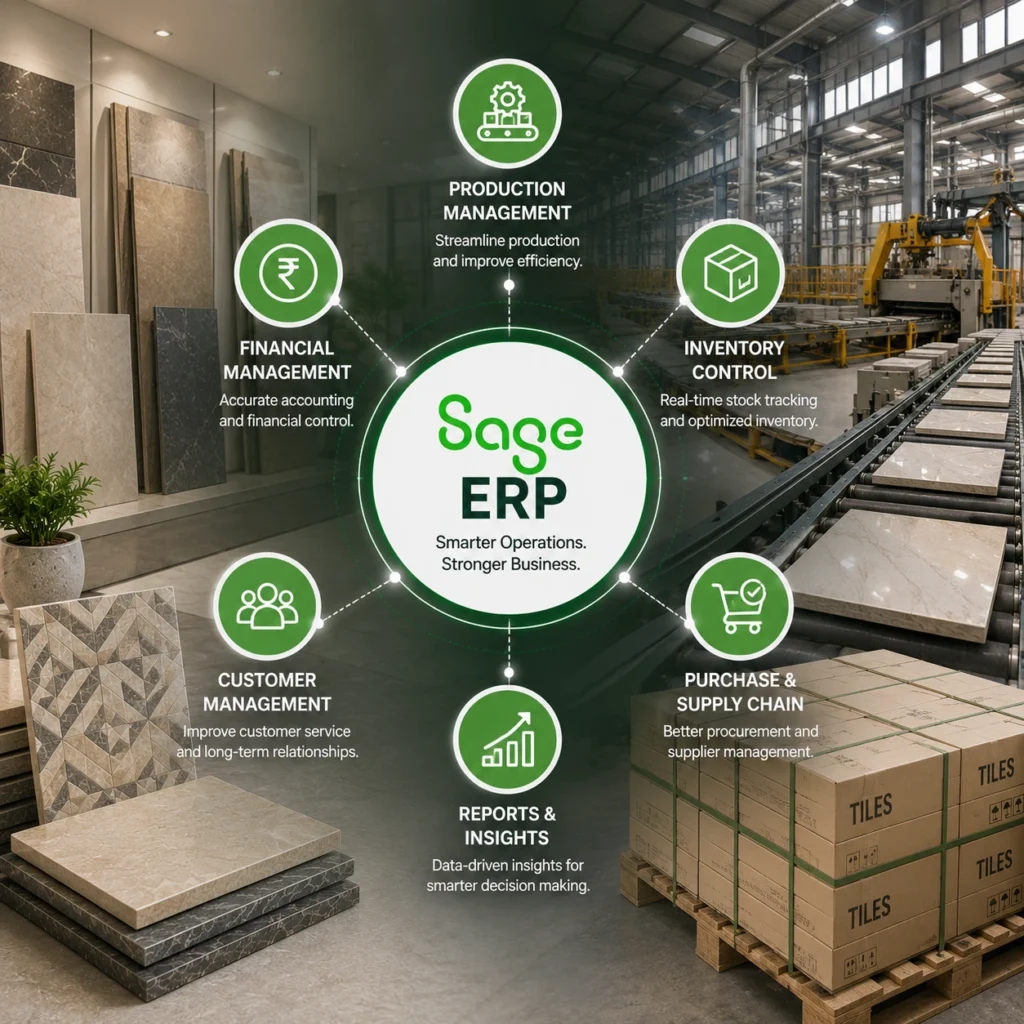
None of that runs off a spreadsheet someone updates on Fridays. The storefront needs live warehouse data, which is the job of an inventory management solution with lot and shade tracking.
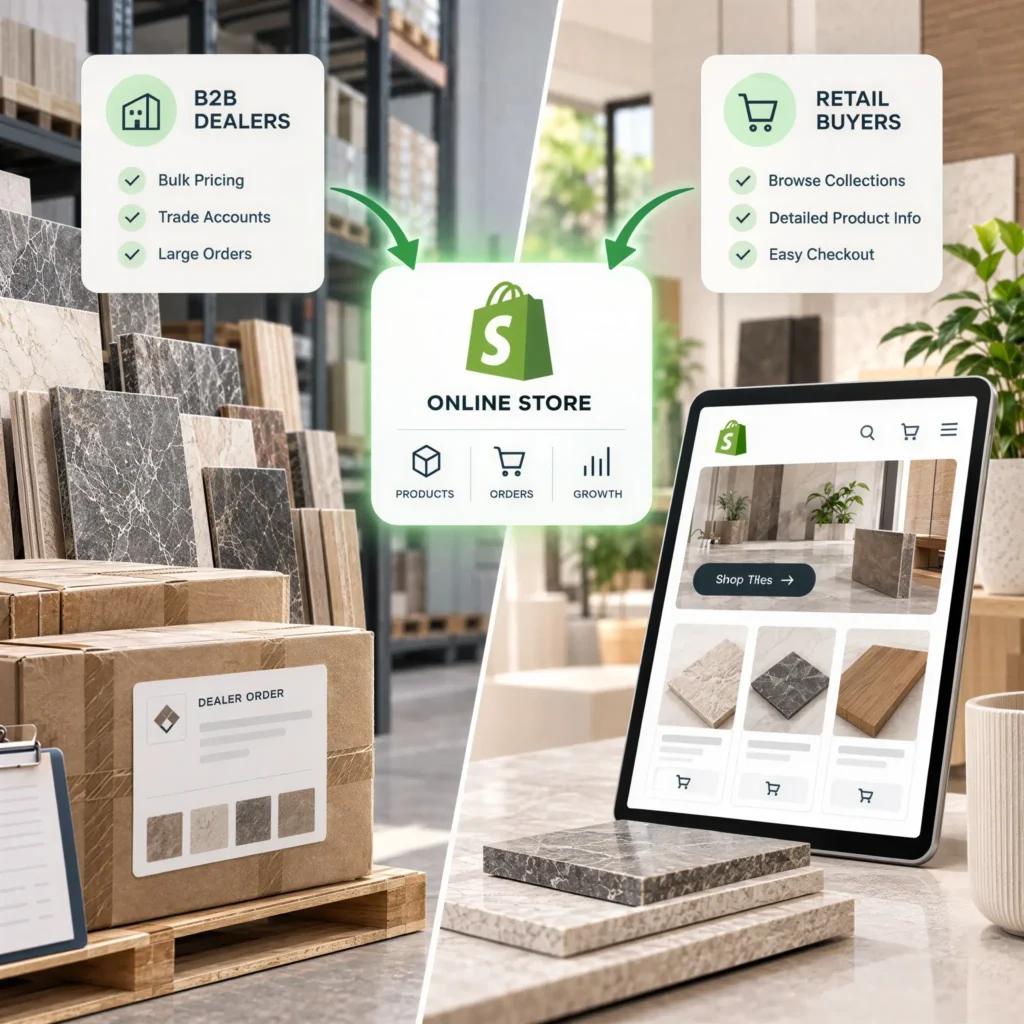
7. Create a Dedicated B2B Buying Experience for Trade Customers
Fabricators and contractors don’t shop like homeowners. They want project pricing, terms and fast reorders, and if the only route is a consumer checkout they’ll phone a competitor. A trade application page, tiered pricing behind a login and a quote button on each slab listing cover most of it. Selling through dealers too? A B2B dealer management solution keeps that channel separate from retail while running off the same catalog.
Common Ecommerce Mistakes That Reduce Large Format Tile Sales
A few we run into again and again:
- Freight that only appears at the final step.
- No handling notes. Slabs ride on edge, never flat, and buyers should hear that before the truck arrives.
- “Contact us for price” with no hint of when anyone will reply.
None needs a rebuild to fix. All three are worth sorting before you spend more on ads.
How to Sell Large Format Tiles Online More Effectively
If your slabs sell well in the showroom but stall online, that’s fixable. Tiles IT Solutions builds ecommerce stores for tile and stone sellers with lot level stock, freight estimates and trade pricing wired in from the start. Book a Consultation with us, tell us how you sell today, and we’ll show you where the gaps are.
FAQs
1. What size counts as a large format tile?
Most of the trade still says any tile with a side of 15 inches or more. The January 2024 ANSI A108 update formally puts it at a facial dimension over 23 inches. Slabs and panels start around 1 square meter.
2. Can porcelain slabs be shipped to a home address?
Yes, usually crated on LTL freight with liftgate and residential fees on top. Have a crew ready, since one slab can top 300 pounds.
3. Should slabs be priced per slab or per square foot?
Per slab, with the square footage shown underneath. Fabricators plan cuts around whole slabs, so that’s how they compare.
4. Do tile visualizers help sell large format tiles?
They do, probably more than with small tiles. People want to see the pattern across a whole room before they even order samples.
5. Which ecommerce platform works best for slabs?
Shopify Plus and Magento can both handle it. The harder parts are lot level stock, freight estimates and trade pricing, which need custom work on either. Our Shopify Plus vs Magento comparison goes into more detail.