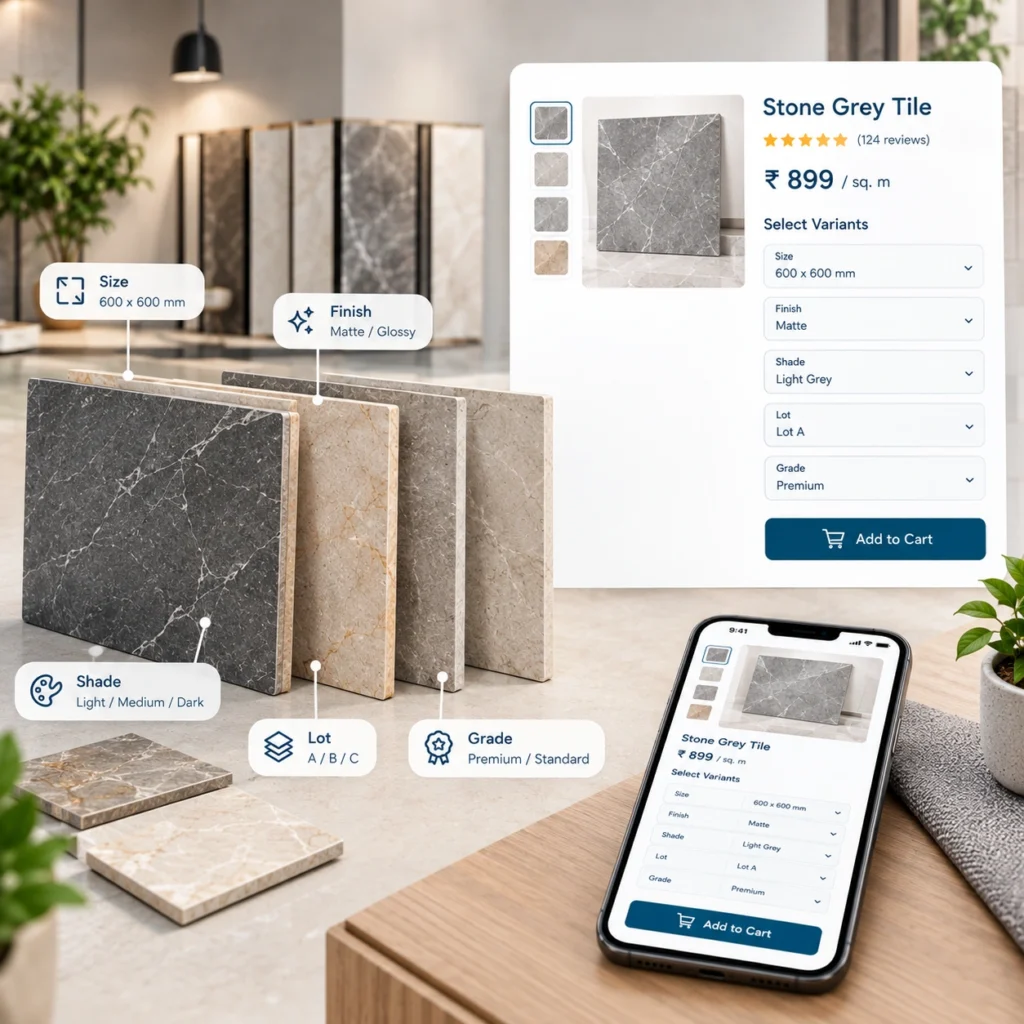
Tile shopping online has a trust problem. A shopper picks a beautiful matte finish on a small thumbnail, waits days for delivery, then unboxes something that looks nothing like what they imagined on their floor. That gap between screen and reality is where sales get lost, returns pile up, and reviews turn sour.
A tile visualizer closes that gap. It lets buyers drop a tile into a photo of their own room, see the scale, the grout, and the shade under real light, and decide with confidence. For online stores, that shift changes almost every metric that matters.
Here’s what a good visualizer actually does for a tile ecommerce business, and why it’s quickly becoming table stakes.
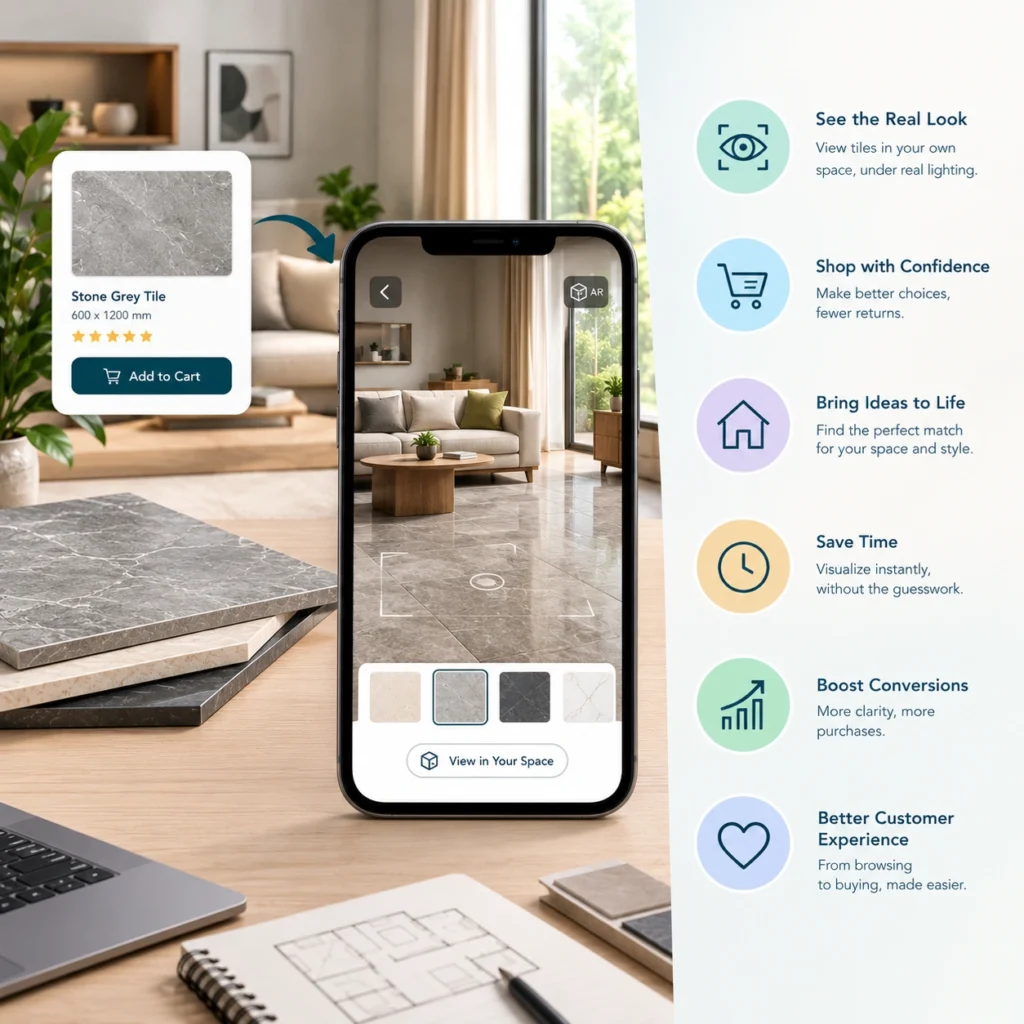
Modern tile shoppers don’t want to imagine. They want to see. A well-built AR and web visualizer, like the ones inside our tile visualization solution, gives them exactly that, right on the product page, no app download needed.
10 Benefits of a Tile Visualizer for Ecommerce Stores
Below are the ten benefits store owners notice first once a tile visualizer goes live. They’re structured differently on purpose, because in practice the impact of each one lands differently too.
1. Let Shoppers Visualize Tiles in Their Own Space
This is the headline benefit, and honestly the one that changes everything downstream. A buyer uploads a photo of their kitchen or bathroom, taps a tile, and watches the pattern fill the floor or wall. Suddenly the decision isn’t abstract.
That single interaction removes the biggest reason people hesitate on tile purchases: fear of getting it wrong.
2. Reduce Tile Returns and Customer Complaints
Returns eat margin. For heavy, fragile products like ceramic and porcelain, they eat it twice, once on shipping out and once on the way back.
Picture a customer who ordered a light grey tile that looked crisp on the product photo. It arrives warmer than expected, and now there’s a return request, restocking work, and a refund. With a visualizer in place, that buyer would’ve seen the warmth against their own wall colour before checkout. Fewer surprises, fewer returns.
3. Increase Average Order Value With Tile Visualization
When shoppers can see a design come together, they tend to buy more of it. A few things happen at once:
- They add a decorative strip or border they wouldn’t have thought about
- They upgrade from standard format to a larger plank because it looks better at scale
- They add a coordinated wall tile after seeing the floor render
- They order extra boxes for future repairs because they’re now emotionally invested
None of that shows up in a spec sheet. It shows up when the room feels real on screen.
Also Read: How Tile Brands Use Room Visualizers to Boost Sales
4. Keep Shoppers More Engaged With Interactive Tile Previews
Session time isn’t a vanity metric for tile stores. Longer sessions usually mean the buyer is comparing, testing, imagining. A visualizer turns a product page into a mini design tool. People linger. They come back. That behaviour feeds directly into rankings and remarketing pools.
5. Make Tile Shopping Easier on Mobile Devices
Most tile buyers browse on phones. Small screens make it hard to judge finish, grain, or grout width from static images.
A visualizer flips that. On mobile, the phone camera becomes the design surface. Buyers point, place, and preview in seconds. It depends on the device, but modern AR handles this smoothly on almost anything from the last four or five years.
6. Help Indecisive Buyers Choose the Right Tile
Here’s a scenario most tile store owners will recognise. A customer chats with support, asks for five samples, promises to order soon, then disappears for weeks. Sometimes forever.
Give that same buyer a visualizer, and the decision loop shrinks. They try three options against their own kitchen wall in ten minutes. Two are clearly wrong. One is clearly right. They order. No sample kit, no waiting, no lost lead.
7. Reduce Unnecessary Tile Sample Requests
Samples aren’t free. There’s the tile cost, packaging, courier fees, and staff time. A visualizer doesn’t kill sample requests entirely, and it shouldn’t. What it does is filter them.
The buyers who still request a sample after using the visualizer are usually further down the funnel and much more likely to convert. That’s a better use of sample budget by a wide margin.
8. Help Customers Experiment With Tile Designs and Layouts
Beyond placing tiles, a strong visualizer helps buyers make design choices they’d normally need a professional for:
- Trying different grout colours to see which reads cleaner
- Testing layout patterns like herringbone, brick bond, or straight lay
- Mixing floor and wall tiles from the same collection
- Comparing a small format against a large one in the same room
Not every buyer needs this, but the ones who do often become the highest value customers.
9. Build Customer Trust and Purchase Confidence
Trust is quiet. You can’t always measure it directly, but you feel it in reduced hesitation, lower cart abandonment, and better review scores. When a buyer has already seen the tile in their space, they arrive at checkout more certain. That certainty carries into the review they leave a month later, which then influences the next buyer.
It compounds.
10. Collect Valuable Product and Shopper Data
Every time a shopper places a tile, tests a grout colour, or saves a design, that’s a data point. Aggregated across thousands of sessions, patterns emerge:
- Which SKUs get previewed but rarely bought
- Which combinations shoppers actually like
- Which colours fail on real walls versus studio shots
- Which layouts win in kitchens versus bathrooms
That data is gold for merchandising, buying, and content planning. It also feeds cleaner recommendations back into the store’s inventory and product pages, especially when the visualizer is wired into a broader ecommerce platform and product catalogue.
What Makes a Tile Visualizer Effective for Ecommerce?
Not every visualizer delivers these results. Some feel gimmicky, others are too slow to be used on the buyer journey.
A few things separate the ones that convert from the ones that don’t:
- Fast load on mobile, even on average connections
- Realistic scaling so a 600 by 600 tile actually looks like a 600 by 600 tile
- Accurate colour rendering under different lighting assumptions
- Easy switch between room upload, camera view, and preset room templates
- Save, share, and revisit designs without forcing account creation
Miss any of these, and adoption stalls. Nail them, and the tool becomes a natural part of shopping.
How Tile Visualizers Integrate With Ecommerce Tools
A visualizer is powerful on its own, but it multiplies when connected to the rest of the store. Tie it to a tile calculator and buyers move from design to quantity in one flow. Wire it into a B2B dealer portal and trade customers can present designs to their own clients before quoting.
That’s the direction ecommerce is heading. Tools that used to sit in a designer’s software are moving straight into the buying experience.
Thinking about adding a visualizer to your tile store? Our team builds visualization tools designed specifically for tile, flooring, and building material catalogues, with clean integration into ecommerce platforms, calculators, and dealer portals. Talk to us about a fit-for-purpose visualization solution and we’ll walk you through options based on your catalogue size and buyer type.
FAQs
1. Do tile visualizers really reduce returns?
Yes, in most cases. When buyers see the tile in their own space, they order what actually fits, not what looked good in a studio photo.
2. Do shoppers need to download an app?
No. Modern web-based visualizers run right in the browser on phones and desktops.
3. Is a visualizer expensive to add to a store?
It depends on scope. A basic room-preview tool costs far less than a full AR-driven system with saved designs and dealer sharing.
4. Does it work on older phones?
Mostly yes. Any phone from the last four or five years handles it comfortably.
5. Will it help SEO?
Indirectly. Longer sessions, lower bounce rates, and better reviews all feed into search performance over time.
6. Can it be used by trade customers, not just homeowners?
Absolutely. Dealers and designers often use it to present ideas to their own clients before finalising orders.