CASE STUDY

End-to-End Ecommerce Partnership That Delivered 40% Faster Execution for CASA 39

A long-term ecommerce partnership that took CASA 39 from operational overload to measurable results: 40% faster project execution, 30% lower costs, 25% better customer engagement, and an 84% satisfaction rate in year one.

View All Case Studies
End-to-End Ecommerce Partnership That Delivered 40% Faster Execution for CASA 39
Ecommerce Partnership

About the Company

CASA 39 sells tiles, bathroom products, and home furnishings across European markets, serving both homeowners and trade buyers. The catalog is wide: floor and wall tiles, sanitaryware, furniture, and accessories across hundreds of brands. Orders come through the main ecommerce site, marketplaces, and a trade channel that runs alongside both. It is a competitive space. Buyers compare prices easily and switch suppliers without much friction, so the digital experience has to do real work.

The Challenges

The business had grown. The internal setup had not kept pace.

CASA 39 was running design, development, marketing, and daily operations as four separate tracks with four separate sets of people and tools. None of them were properly connected. The development team had a backlog of requests from marketing that kept growing. Marketing was launching campaigns without consistent tracking in place. Operations were absorbing hours that should have been going toward growth work.

The damage was not obvious from inside any single team. Each one had a reason for the delays. But step back and the pattern was clear: projects were taking longer than they should, campaigns could not be measured properly, and the customer experience was inconsistent depending on which channel a buyer came through.

There was also no single person watching the whole picture. If something slipped between teams, it slipped. Nobody owned the outcome end to end.

Our Solution

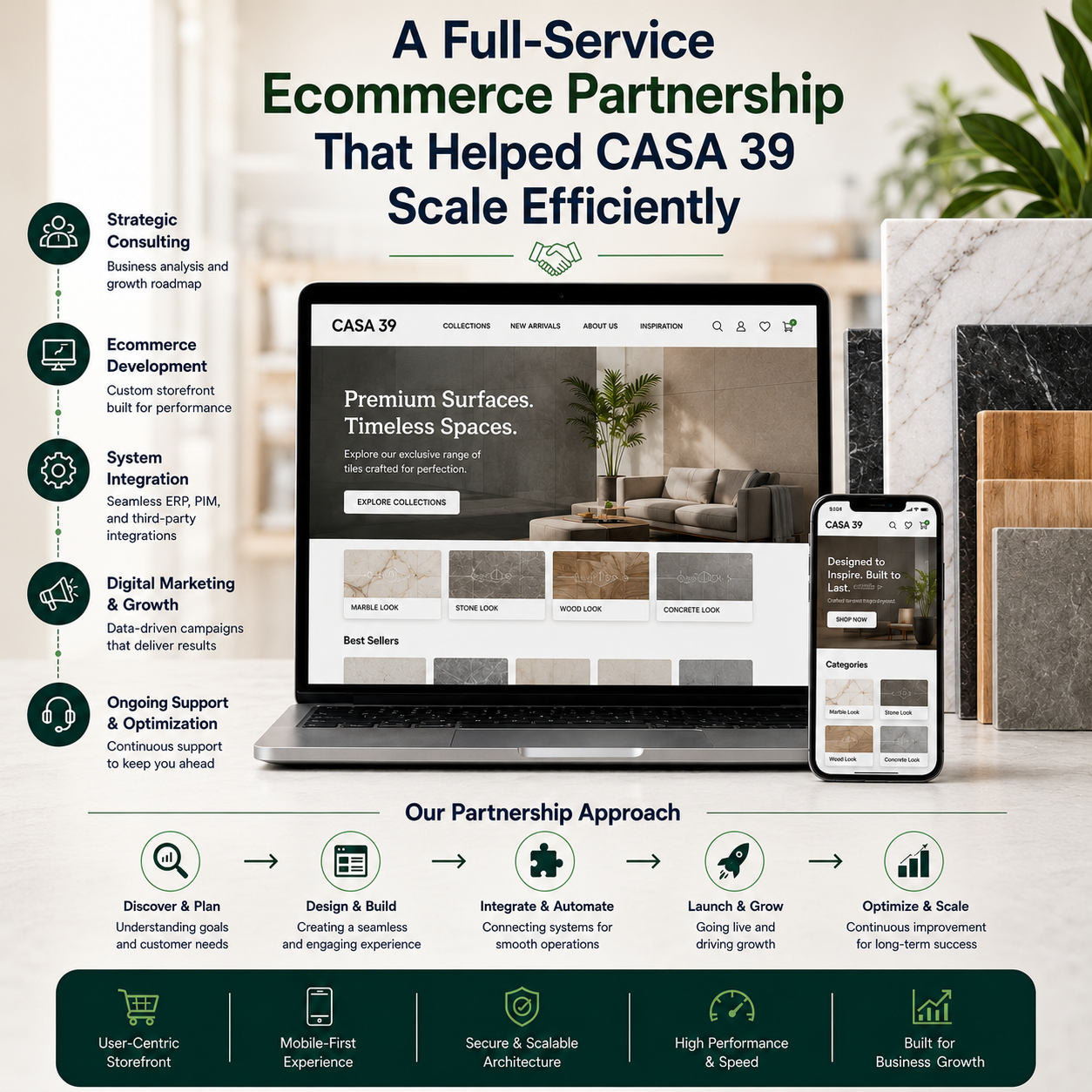
Tiles IT Solutions took on the full scope: platform development, marketing, operations, and client success, all under one engagement with one point of accountability.

The speed improvement came almost immediately. When a campaign needed a new landing page, the same team built it. No briefing document sent to a separate agency, no waiting on a reply, no version going back and forth between two sets of people who were not sitting together. The page went live when the campaign went live. That alone changed how fast things moved.

The Magento platform sits on Linux, with Apache serving requests, MySQL holding the product and order data, PHP running the application layer, and JavaScript handling the front end. Running on this stack rather than a hosted SaaS platform means the team can reach into any layer of the system. A page speed problem, a custom filter requirement, a checkout change for a specific market: none of these require going through a platform vendor's support queue. The same people who manage the marketing campaigns can push a fix to the server the same afternoon.

Campaign tracking was in a bad state before we started. Tags were missing. UTM conventions were inconsistent across channels. Some conversions were being counted twice; others were not being counted at all. We stopped everything and ran a full audit before any new campaigns went live. Three weeks of cleanup work. Every event verified, every source tagged correctly, a clean baseline established from scratch. Only then did we start spending.

Once tracking was solid, customer lifecycle email sequences were built out properly, segmented by what buyers had purchased and what they had browsed but not bought. Behavioural drop-off data from the site fed into ongoing changes to the product pages and checkout.

A Client Success Manager was assigned permanently to the account to keep the delivery roadmap aligned to CASA 39's business targets and handle any sales channel issues before they became problems.

Before and After Scenario

Before: Four separate teams, four separate tools, no single owner for the outcome. A campaign might launch without a tracking tag because nobody had checked. A development request from marketing could sit in a backlog for weeks. The leadership team spent a significant portion of their time coordinating between vendors rather than making decisions about the business.

After: One team, one contact, one set of priorities. A campaign and its landing page go live together. Every conversion event is tracked and attributed correctly. The Client Success Manager runs a weekly check on targets and flags issues before they affect revenue. Leadership stopped managing the process and started reviewing the results.

Tech Stack

MagentoMagento
PHPPHP
ApacheApache
MySQLMySQL
LinuxLinux
JavaScriptJavaScript

Business Outcomes

  • 40% faster project execution once development and marketing were running from the same team
  • 30% reduction in operating costs from consolidating four vendor relationships into one
  • 25% improvement in customer engagement after campaigns had proper tracking and segmentation in place
  • 84% customer satisfaction rate, with a target above 90% set for the year following
  • Revenue growth sustained post-launch through ongoing channel management rather than a one-time build
  • Attribution data made usable after a three-week tracking audit that ran before any new budget was committed

CASA 39 was not struggling because any one team was doing a bad job. The problem was the gaps between teams. Getting one partner to own the whole picture, from server to campaign, is what closed those gaps.

Ecommerce partnership Campaign tracking Project execution
YOUR PROJECT NEXT

Ready to See What We Can Build for You?

Every project in our portfolio started with a conversation. Let's discuss your challenges.

Book a Consultation