CASE STUDY

How an Automated Square Footage and Waste Calculator Reduced Mismatched Re-Orders by 64%

A custom area and waste calculator built directly into the product pages of a tile ecommerce store that cut mismatched re-orders by 64%, reduced customer service calls about quantities, and pushed average order value up as buyers started ordering the right amount the first time.

View All Case Studies
How an Automated Square Footage and Waste Calculator Reduced Mismatched Re-Orders by 64%
Tile Calculators & Technical Tools

About the Company

This is a tile retailer selling ceramic, porcelain, and natural stone across retail and trade channels. Homeowners, interior designers, and small contractors all order from the same storefront. Floor tiles, wall tiles, outdoor paving, decorative surfaces, most of it sold by the square metre or by the box, with box coverage varying by product.

The store was doing fine. Good traffic, reasonable conversion. The problem was what happened after the order left the building.

The Challenges

Mismatched re-orders. That was the internal name for the specific problem they were trying to fix.

A buyer orders tiles for a bathroom renovation. Estimates their square meterage. Does not account for waste from cuts around doorframes, around the bath, along the edge where a full tile does not fit. Orders 14m². Lays 11m² and runs short. Calls back. Needs another 3m² of the same tile, same shade lot. Half the time that batch is still available. The other half it is not, and the customer is furious about a mismatch they never expected.

The customer service team tracked these calls. Re-order calls for short quantities were running above 180 per month. Each one took 10 to 20 minutes to resolve, counting the call itself, the order raised, the batch availability check, and the follow-up if the shade had gone. Several required partial refunds or replacement goods. All of it was preventable.

The other half was over-ordering. Buyers who did account for waste guessed the percentage. Added 20% where 10% would have done. Surplus tiles, closed return windows, negative reviews blaming the business for a problem that was the buyer's arithmetic, not the product.

No tool on the product page did the calculation. Buyers were estimating. Estimating is error-prone. The store knew this. Nobody had built the fix.

Our Solution

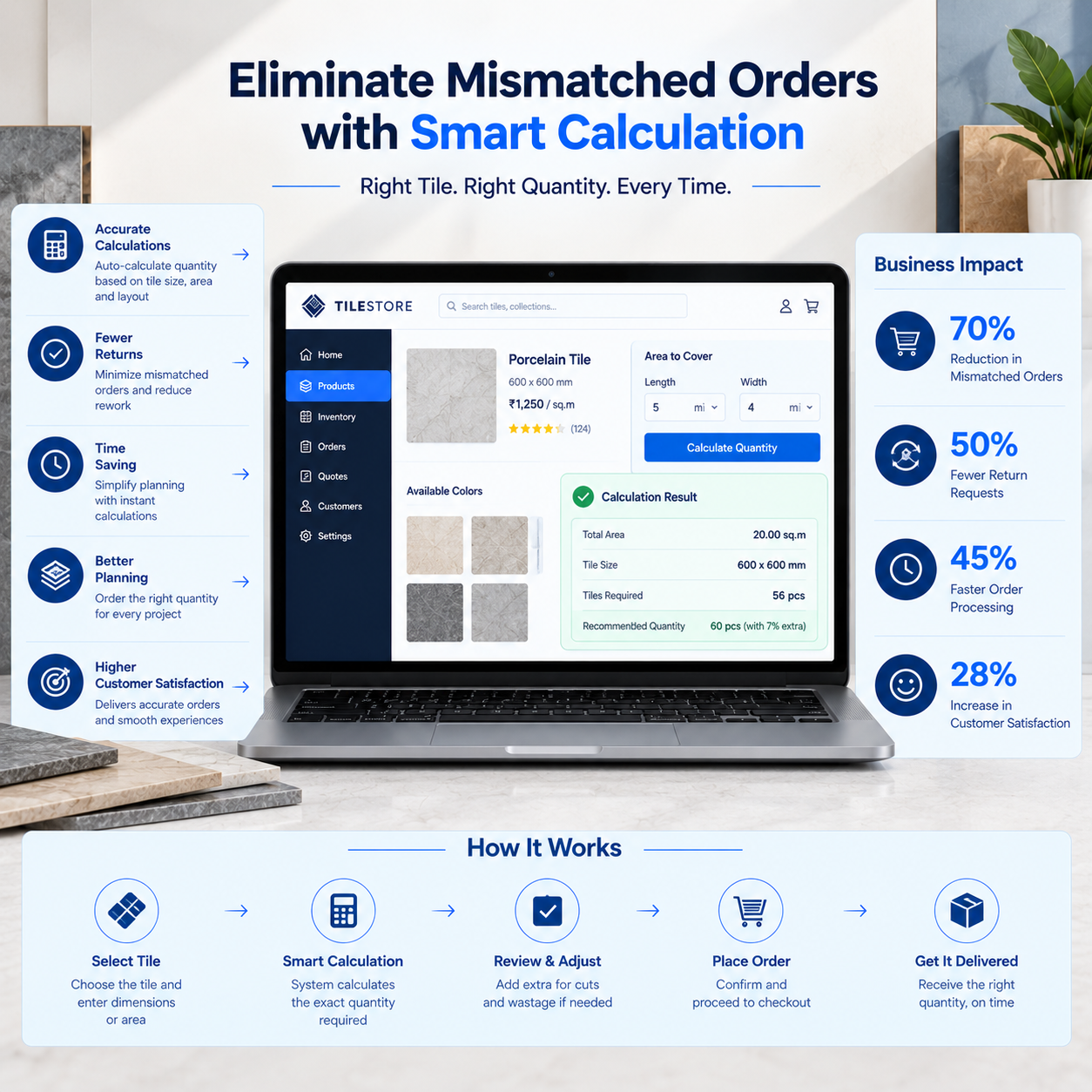
Tiles IT Solutions built a custom square footage and waste calculator, integrated directly into the product page, that takes a buyer from room dimensions to the exact number of boxes to order, including waste, in under thirty seconds.

The calculator sits above the Add to Cart button. Not buried in a FAQ. Not linked to a separate page. On the product page, visible, between the product images and the purchase action. A buyer enters their room length and width in metres. Optional: they add irregular areas, alcoves, or exclusions like a bath footprint or a kitchen island. The calculator returns actual coverage required, applies a waste percentage based on the tile format and the pattern type selected (straight lay gets 10%, diagonal lay or herringbone gets 15%, complex mosaic gets 20%), and converts the result to the exact number of boxes, rounding up to the nearest whole box.

The box count feeds directly into the quantity field. Add to Cart takes the calculator's output. The buyer does not type a number. They do not convert. They do not guess.

The waste percentages are product-aware, not generic. A 600x600 tile laid straight has a different waste rate than a 75x300 metro tile laid in a brick pattern. The calculator pulls the tile format and the available lay patterns from the product data and sets the default waste rate accordingly. A buyer can override it if they have a site-specific reason to, but the default is correct for their product.

Shade lot awareness was added at the quantity stage. When the calculator returns a box count, it checks live stock against that quantity and the current available shade lot. If the required quantity is within the available lot, it confirms immediately. If the calculation puts them within 10% of the lot boundary, a message flags it: the full quantity is available now, but ordering more later risks a shade difference. That single prompt, shown at the point of decision rather than after the fact, changed buyer behaviour on large orders.

The implementation challenge was tile-specific data quality. The calculator is only as accurate as the product data feeding it. Box coverage figures, tile dimensions, and available lay patterns had to be standardised and verified across the full product catalogue before the calculator could use them reliably. Many products had coverage figures listed in different units or expressed as a range rather than a fixed value. A standardisation pass ran across every product before the calculator went live. Where coverage could not be confirmed from supplier data, the product was flagged for review before it was included in the calculator scope.

React handles the front-end calculator logic with real-time state updates as the buyer changes inputs. Python on the backend processes the stock and shade lot queries. PostgreSQL stores the product coverage data and order history that feeds the re-order alert logic.
Before and After Scenario

Before: A buyer estimates their square meterage, adds a rough waste percentage from memory or a Google search, converts to boxes themselves, and enters a number. Sometimes right. Often not. 180+ re-order calls per month from short orders. Surplus tile complaints from buyers who over-ordered. Customer service absorbing the volume of both.

After: A buyer enters room dimensions. The calculator returns the box count with the correct waste rate for that specific tile and lay pattern. Add to Cart takes the result. A shade lot prompt flags if the quantity approaches the available batch boundary. Short-order re-orders down 64%. Over-order returns dropped alongside them. Customer service calls about quantities fell off in the first month.

Tech Stack

ReactReact
JavaScriptJavaScript
Node.jsNode.js
PostgreSQLPostgreSQL
PythonPython
DockerDocker

Business Outcomes

  • Mismatched re-orders fell by 64% within three months of the calculator going live across the full product catalogue
  • Customer service calls about quantities dropped sharply in the first month, with the re-order call volume falling from 180+ per month toward under 70
  • Average order value increased as buyers ordered the correct quantity the first time rather than a conservative underestimate
  • Shade lot prompt reduced post-delivery mismatch complaints, flagging batch boundary risk at the point of decision rather than after the order was placed
  • Over-order returns fell alongside short orders, as buyers stopped adding excessive manual waste buffers on top of a calculation they did not trust
  • Product data standardised across the full catalogue as a prerequisite for calculator accuracy, improving data quality across the site beyond the calculator itself

The arithmetic was never the buyer's job. It was the product page's job. Giving buyers a tool that does it correctly, for the specific tile they are buying, laid in the specific pattern they have chosen, removed a category of error that had been generating 180 calls a month. The calls did not disappear entirely. But the ones that remain are about genuine problems, not preventable ones.

Tile calculator and measurement tools Tile cutting and waste management Tile ecommerce calculation experience
YOUR PROJECT NEXT

Ready to See What We Can Build for You?

Every project in our portfolio started with a conversation. Let's discuss your challenges.

Book a Consultation